When to prune roses
For repeat-flowering roses — hybrid teas and floribundas — the answer is late winter, when growth is just resuming. The RHS puts that at mid-February in the south of Britain and March in northern and colder areas, and American extension services describe the same window landing anywhere from mid-to-late February near the coast to mid-April in the mountains. The reliable signal is not a date but the plant: prune when the buds start to swell, which many growers time by watching for forsythia to flower.
Updated on 2026-10-07.
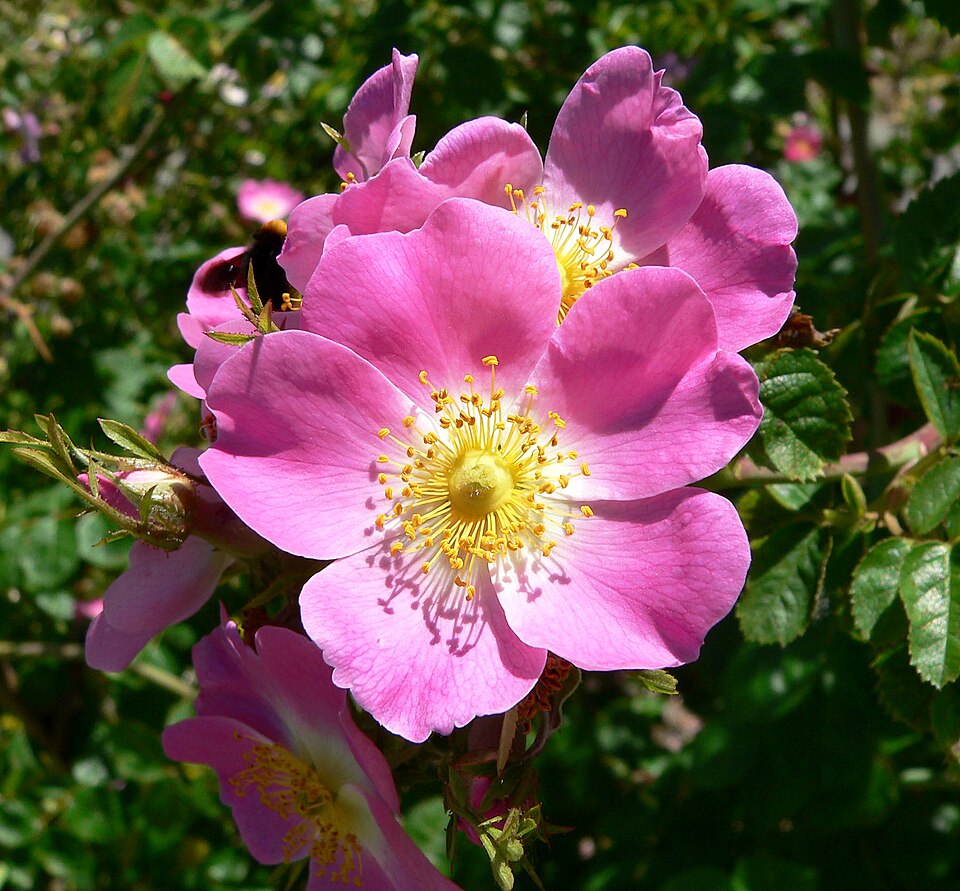
Roses: the type decides the month, and the swelling bud decides the day.
The facts in one table
| Climate band | Months | Sign on the plant |
|---|---|---|
| Northern hemisphere — mild winter, roughly USDA 7–9 | Feb · Mar | The buds begin to swell, or forsythia starts to flower nearby |
| Southern hemisphere — mild winter | Aug · Sep | The buds begin to swell, or forsythia starts to flower nearby |
| Northern hemisphere — cold winter, roughly USDA 4–6 | Mar · Apr | Buds swell after the hardest frosts have passed |
| Southern hemisphere — cold winter | Sep · Oct | Buds swell after the hardest frosts have passed |
| Northern hemisphere — almost frost-free, roughly USDA 9–10 | Jan · Feb | Growth resumes; prune before the first flush |
| Southern hemisphere — almost frost-free | Jul · Aug | Growth resumes; prune before the first flush |
Sources written in the northern hemisphere give northern months. The southern row is the same job shifted by six months, which is an approximation of the season — the sign on the plant is what you should actually act on.
Sources: Royal Horticultural Society · Royal Horticultural Society · University of Illinois Extension · Clemson Cooperative Extension (HGIC)
The type of rose changes the month completely
Repeat-flowering bush roses are the late-winter case, and they are what most "when to prune roses" answers are about. Climbing roses are different: the RHS describes pruning them in winter after the flowers have faded, between December and February, with long whippy shoots shortened or tied in during autumn so wind does not damage them. Rambling roses are different again — the RHS routinely prunes them in late summer, after their show of flowers and hips, with renovation possible any time between late autumn and late winter.
Getting this wrong is the commonest way to lose a season of flowers. A rambler pruned in late winter has just had next summer's flowering wood removed, because it flowers on growth made the previous year. The question to settle before picking up the secateurs is not when, but what kind of rose this is.
Sources: Royal Horticultural Society · Royal Horticultural Society · Royal Horticultural Society
Why late winter and not autumn
University of Illinois Extension puts the reasoning plainly: late winter to early spring is warm enough to avoid winter injury yet still cool enough to minimise the spread of insects and disease. Pruning in autumn leaves fresh cuts and stimulates soft growth going into the cold, and pruning in full growth wastes the plant's stored energy. The narrow window between dormancy breaking and growth starting is where the cut costs least.
The practical test from Clemson Extension is to look at the buds: when they begin to swell, prune. The forsythia rule of thumb works for the same reason — it is a plant responding to the same accumulated warmth, so it is a local thermometer rather than a date.
Sources: University of Illinois Extension · Clemson Cooperative Extension (HGIC)
Hemisphere and hardiness zone
Every month in the published guidance is a northern-hemisphere month, because the RHS is in Britain and the extension services are in the United States. South of the equator, late winter falls around August and September, so the table above shifts the window by six months. That is an approximation of the season rather than a precise transposition, which is exactly why the sign-on-the-plant column is there.
Within a hemisphere the spread is still large, and that is what hardiness zones describe. The USDA Plant Hardiness Zone Map, updated in 2023, maps average annual extreme minimum temperature, and Clemson notes that a cultivar bred to be hardy in zone 4 will need little or no added protection in a zone 7b garden. Knowing your zone tells you which row of the table you are in; it does not replace watching the buds.
Sources: USDA Agricultural Research Service · Clemson Cooperative Extension (HGIC) · University of Illinois Extension
How hard to cut
The RHS gives different amounts for the two main bush types, and the difference is deliberate. Hybrid teas are pruned low to force vigorous new shoots: the strongest remaining shoots are shortened to four to six buds, about 10–15 cm from the base, and weaker shoots to two to four buds, about 5–10 cm. Floribundas are left longer, with the strongest shoots cut back to within 25–30 cm of soil level, because the mass of flowers the type is grown for comes from more buds.
Source: Royal Horticultural Society
Prune: Roses (repeat-flowering bush types)
Watch the buds, not the calendar. Pruning too early invites dieback if a hard frost follows.
| Climate band | Months | Sign on the plant |
|---|---|---|
| Northern hemisphere — mild winter, roughly USDA 7–9 | Feb · Mar | The buds begin to swell, or forsythia starts to flower nearby |
| Southern hemisphere — mild winter | Aug · Sep | The buds begin to swell, or forsythia starts to flower nearby |
| Northern hemisphere — cold winter, roughly USDA 4–6 | Mar · Apr | Buds swell after the hardest frosts have passed |
| Southern hemisphere — cold winter | Sep · Oct | Buds swell after the hardest frosts have passed |
| Northern hemisphere — almost frost-free, roughly USDA 9–10 | Jan · Feb | Growth resumes; prune before the first flush |
| Southern hemisphere — almost frost-free | Jul · Aug | Growth resumes; prune before the first flush |
Sources: Royal Horticultural Society · University of Illinois Extension · Clemson Cooperative Extension (HGIC)
What most people get wrong
- "Prune all roses in late winter." Climbers are pruned in winter after flowering (December to February per the RHS) and ramblers in late summer, after their flowers and hips.
- "There is one correct month." The published window runs from mid-February to mid-April across climate bands in the northern hemisphere alone, and shifts about six months in the south.
- "Autumn pruning tidies the garden for winter." It risks winter dieback; extension guidance is explicit about not pruning too early.
- "Hard pruning suits every bush rose." Hybrid teas are cut low; floribundas are left longer, because the flowering habit differs.
Sources: Royal Horticultural Society · Royal Horticultural Society · University of Illinois Extension
Frequently asked questions
- What month should I prune roses?
- For repeat-flowering bush roses, late winter: the RHS gives mid-February in the south of Britain and March in colder areas, and US extension services describe mid-February to mid-April depending on the region. In the southern hemisphere the equivalent is around August and September.
- How do I know it is the right time?
- Look at the buds. Clemson Extension advises pruning when they begin to swell; many growers use the first forsythia flowers as the local signal.
- When do I prune a climbing rose?
- In winter after the flowers have faded — the RHS gives December to February — with long whippy shoots shortened or tied in during autumn.
- When do I prune a rambling rose?
- In late summer, after its flowers and hips. Renovation can be done any time between late autumn and late winter.
How to read the numbers
The numbers on “When to prune roses” come from the facts table at the top, with the official source alongside.
Where the data comes from
Each section of “When to prune roses” names its source (agency, university or breed club) with a verification date.
What this page doesn’t replace
Educational information, not a substitute for a vet, agronomist or specialist assessing your specific case.
More about this page
The Roses (repeat-flowering bush types) calendar changes with the hemisphere
Pruneing Roses (repeat-flowering bush types) has 6 windows recorded here, split between the northern and southern hemisphere — because February in Brazil is August in Europe, and copying the month from a guide written for the wrong hemisphere rushes or delays the plant.
Words on this page
Formative pruning vs. maintenance pruning
Formative pruning happens in a plant’s first years and sets the permanent shape of the main branches; maintenance pruning is yearly, removes dead, diseased or crossing branches, and does not change the plant’s architecture. Mixing the two up is the most common reason a fruit tree fails to bear fruit.
Dormancy
The period when a plant slows its metabolism and stops visible growth, usually in autumn and winter, to survive cold or drought. Pruning, transplanting or fertilising during dormancy is usually less stressful for the plant than doing it in full growth.
Hardiness zone
A numbered band that ranks a region by the average coldest winter temperature it reaches, used to tell whether a plant survives there outdoors. The reference system is the US one (USDA), from zone 1, coldest, to 13, warmest.
Standard definition by USDA — Agricultural Research Service, Plant Hardiness Zone Map · Hardiness zone
Hemisphere
Half of the globe split by the equator. The seasons flip between the two: when it is winter in the northern hemisphere, it is summer in the southern one, which shifts the pruning, bloom and harvest calendar described on this page.
Life cycle
The sequence of stages an organism passes through from birth to death — for an animal, young, adult and senior; for a plant, germination, growth, flowering and, in annuals, death after setting seed.
Toxicity
A plant’s or substance’s capacity to harm an organism, which varies with the species exposed, the amount ingested and the animal’s size. A plant "toxic to dogs" is not necessarily toxic to humans at the same dose, and the reverse holds too.
Standard definition by ASPCA — Animal Poison Control Center · Toxicity
Sources
- Rose Pruning: Floribunda & Hybrid Tea Roses — Royal Horticultural Society. Checked on 2026-10-07.
- Rose pruning guide — Royal Horticultural Society. Checked on 2026-10-07.
- Roses — Pruning — University of Illinois Extension. Checked on 2026-10-07.
- Pruning Roses — Clemson Cooperative Extension (HGIC). Checked on 2026-10-07.
- Rose Pruning: Climbing Roses — Royal Horticultural Society. Checked on 2026-10-07.
- Rose Pruning: Rambling Roses — Royal Horticultural Society. Checked on 2026-10-07.
- USDA Plant Hardiness Zone Map (2023) — USDA Agricultural Research Service. Checked on 2026-10-07.