What do deer eat?
Not grass, mostly. White-tailed deer are classified as browsers because they live primarily on browse — the buds, stems, leaves and bark of woody plants — and on forbs, the broad-leaved herbaceous plants. Add soft mast such as berries and hard mast such as acorns, beechnuts and hickory nuts, and you have the four forage categories the USDA Forest Service identifies as most important across most of the species' range.
Updated on 2026-10-07.
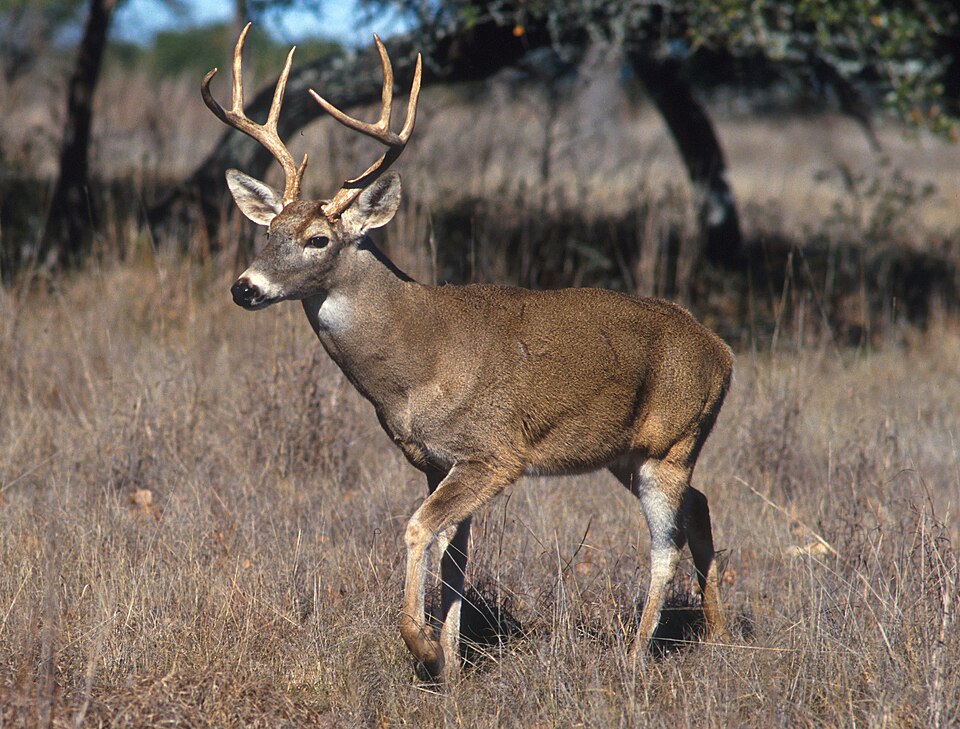
White-tailed deer (Odocoileus virginianus): a selective browser working at shrub height.
The facts in one table
| Feeding type | herbivore — a browser, not a grazer |
| Main forages | Forbs, browse, soft mast (berries, drupes, pomes) and hard mast (acorns, beechnuts, hickory nuts) |
| Plant parts taken | Buds, fruits, seeds, stems, leaves and bark of trees and shrubs |
| Late summer to early winter | Fruits and nuts make up a large part of the diet; acorns dominate in autumn where available |
| Preferred browse in Pennsylvania | Blackgum, oak, basswood, maple, tulip poplar, aspen, hickory, ash and pin cherry |
Source for each row: Penn State Extension and USDA Forest Service (Fire Effects Information System).
Sources: Penn State Extension · USDA Forest Service
Browser, not grazer — and why that matters
A grazer crops grass at ground level; a browser works at waist and shoulder height, selecting the growing tips of shrubs and young trees. Deer are browsers, and that single fact explains almost everything gardeners and foresters complain about. The damage shows up on the parts of a plant that drive its growth, in a band from the ground up to about the height of the animal's head.
It also explains why deer are selective rather than indiscriminate. Penn State Extension describes preferred foods being eaten first, marginal foods only when the preferred ones become scarce, and starvation foods only when nothing else is left. Which species end up in which category is local: in Pennsylvania, work compiled by the Bureau of Forestry and others identifies blackgum, oak, basswood, maple, tulip poplar, aspen, hickory, ash and pin cherry as preferred browse.
Sources: Penn State Extension · USDA Forest Service
Autumn is about acorns
Penn State Extension notes that from late summer to early winter fruits and nuts make up a large part of a deer's diet, and that acorns form a significant portion of the autumn diet when available. The qualifier matters: oak mast crops swing enormously from year to year, so the autumn diet in a heavy acorn year looks nothing like the autumn diet after a failure. Deer movement, body condition and the pressure they put on other plants all follow that cycle.
Source: Penn State Extension
Deer in a garden
Because deer are selective browsers, a garden reads to them as a concentration of preferred food at exactly the right height. The honest conclusion from the extension literature is that food choice shifts with availability, so "deer-resistant" plant lists describe a preference, not a rule — the same plant can be ignored in a good mast year and stripped in a bad one. Fencing is the only approach that does not depend on the animal's mood.
The same logic applies to woodland. Where deer numbers are high, browsing removes the seedlings and saplings of exactly the preferred species listed by the Bureau of Forestry, so the next generation of forest is quietly edited by diet. That is why extension services talk about enhancing browse across an area rather than feeding animals in one spot.
Sources: Penn State Extension · USDA Forest Service
What most people get wrong
- "Deer eat grass." They are browsers: forbs and woody browse, plus soft and hard mast, are the important forages.
- "Deer-resistant plants are safe." Penn State describes preferred, marginal and starvation foods — when preferred food runs out, the list changes.
- "Feeding deer helps them through winter." Supplementary feeding concentrates animals and does not fix a diet built on dispersed browse; extension services recommend improving browse instead.
Sources: Penn State Extension · USDA Forest Service
Frequently asked questions
- Do deer eat acorns?
- Yes — Penn State Extension says acorns form a significant portion of the autumn diet when available, and that fruits and nuts are a large part of the diet from late summer to early winter.
- What is "browse"?
- The buds, stems, leaves and bark of woody plants. Deer are classified as browsers because browse and forbs, not grass, make up most of the diet.
- Are deer selective about what they eat?
- Very. Preferred foods go first, marginal foods are eaten when the preferred ones become scarce, and starvation foods only when nothing else is available.
How to read the numbers
The numbers on “What do deer eat?” come from the facts table at the top, with the official source alongside.
Where the data comes from
Each section of “What do deer eat?” names its source (agency, university or breed club) with a verification date.
What this page doesn’t replace
Educational information, not a substitute for a vet, agronomist or specialist assessing your specific case.
Words on this page
Toxicity
A plant’s or substance’s capacity to harm an organism, which varies with the species exposed, the amount ingested and the animal’s size. A plant "toxic to dogs" is not necessarily toxic to humans at the same dose, and the reverse holds too.
Standard definition by ASPCA — Animal Poison Control Center · Toxicity
Life cycle
The sequence of stages an organism passes through from birth to death — for an animal, young, adult and senior; for a plant, germination, growth, flowering and, in annuals, death after setting seed.
Hypoallergenic
A term used for breeds that shed less allergen into the environment, usually because they shed less fur. No dog or cat breed is fully allergen-free: a cat’s main allergen comes from saliva and skin, not only fur, and a very sensitive person can react to any breed.
Standard definition by American Kennel Club · Hypoallergenic
Hemisphere
Half of the globe split by the equator. The seasons flip between the two: when it is winter in the northern hemisphere, it is summer in the southern one, which shifts the pruning, bloom and harvest calendar described on this page.
Dormancy
The period when a plant slows its metabolism and stops visible growth, usually in autumn and winter, to survive cold or drought. Pruning, transplanting or fertilising during dormancy is usually less stressful for the plant than doing it in full growth.
Formative pruning vs. maintenance pruning
Formative pruning happens in a plant’s first years and sets the permanent shape of the main branches; maintenance pruning is yearly, removes dead, diseased or crossing branches, and does not change the plant’s architecture. Mixing the two up is the most common reason a fruit tree fails to bear fruit.
Sources
- White-Tailed Deer — Penn State Extension. Checked on 2026-10-07.
- Odocoileus virginianus, white-tailed deer (Fire Effects Information System) — USDA Forest Service. Checked on 2026-10-07.