What do rabbits eat?
Almost all of it is hay and grass. The RSPCA and PDSA both describe the same split: around 85% good-quality, high-fibre hay and grass, about 10% safe leafy greens and herbs, and only about 5% commercial pellets or nuggets. A useful way to picture the hay portion is the one the RSPCA gives — a bundle of hay every day roughly as big as the rabbit itself.
Updated on 2026-10-07.
This page describes what the animal eats in the wild and, where relevant, in human care. It is general information, not a consultation: if an animal is unwell or has eaten something it should not have, consult a veterinarian.
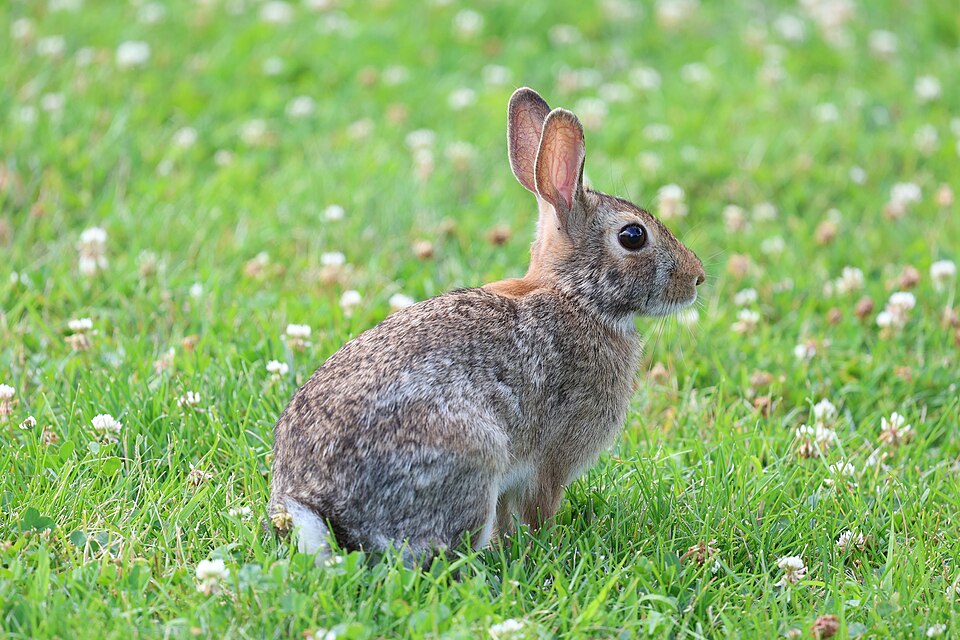
Eastern cottontail (Sylvilagus floridanus) grazing — the wild version of the same high-fibre diet.
The facts in one table
| Feeding type | herbivore |
| Hay and grass | 85% of what a pet rabbit eats, available at all times |
| Leafy greens, herbs and safe weeds | 10% of the diet, a large handful daily, rotated |
| Pellets or nuggets | 5% of the diet, a small measured ration |
| Not recommended | Muesli-style mixes, which encourage selective feeding |
Source for each row: RSPCA and PDSA rabbit diet guidance.
Why hay does the heavy lifting
A rabbit is a grazing animal with teeth that keep growing and a gut that needs a constant stream of fibre moving through it. Long-fibre forage answers both at once: the chewing wears the teeth down at roughly the rate they grow, and the fibre keeps the digestive system working. That is why the welfare charities put hay and grass at 85% and say it should be available all the time rather than offered as a meal.
The practical test is simple. If the hay rack empties and the pellet bowl does not, the proportions are wrong. The RSPCA describes good hay as sweet-smelling and dust-free, and the daily amount as a rabbit-sized bundle — a quantity most people under-estimate badly.
Greens and pellets: the remaining 15%
The greens portion is about 10% of the diet: a large handful of washed, safe leafy greens, herbs and weeds a day. Both charities make the same point about variety — offer a mix of several greens and rotate them, rather than feeding the same two or three every day. Pellets are the smallest slice, around 5%, and they exist to fill the gaps in vitamins and minerals, not to be the meal.
The food to leave on the shelf is muesli-style mix. The RSPCA explains why: these products combine flaked maize, peas, pellets, grains and seeds, and rabbits pick out the tastier low-fibre bits and leave the nutritious ones. The result is an unbalanced diet with a higher risk of serious dental and digestive problems.
This page describes what the animal eats in the wild and, where relevant, in human care. It is general information, not a consultation: if an animal is unwell or has eaten something it should not have, consult a veterinarian.
Wild rabbits eat the same way, without the bowl
Wild rabbits such as the eastern cottontail live on grasses and other low vegetation through the growing season and shift to woodier material — twigs, bark and buds — when green growth disappears. The pattern is the same as the pet diet for the same reason: a hindgut fermenter needs volume and fibre, not concentrated food. It is also why a garden with young shoots is such an attractive target, and why fencing works better than any attempt at feeding them elsewhere.
Sources: U.S. Fish and Wildlife Service · U.S. Fish and Wildlife Service
What most people get wrong
- "Rabbits live on carrots." Carrot is a sugary root and belongs, at most, in the small treat category. Leafy greens are the 10% portion; hay is the 85%.
- "The bag of muesli mix is a complete food." The RSPCA advises against muesli-style foods precisely because rabbits eat selectively from them and leave the fibre behind.
- "Pellets are the meal and hay is bedding." It is the other way round: hay and grass are 85% of the diet, and pellets are a small measured ration.
- "Any garden green is fine." Only safe, washed leafy greens, and a new green should be introduced gradually; a plant you cannot identify is not food.
Frequently asked questions
- How much hay does a rabbit need a day?
- The RSPCA gives the guide of a rabbit-sized bundle of good-quality hay every day, available at all times, making up about 85% of what the animal eats.
- How many pellets should a rabbit get?
- A small, measured ration — about 5% of the daily diet — to cover vitamins and minerals. The amount depends on the animal, so check it with a veterinarian.
- Why are muesli-style rabbit foods discouraged?
- Because rabbits selectively eat the tastier, lower-fibre ingredients and leave the more nutritious parts, which the RSPCA links to dental and digestive problems.
- What do wild rabbits eat in winter?
- They move from grasses and green vegetation to woodier material such as twigs, bark and buds when green growth is not available.
How to read the numbers
The numbers on “What do rabbits eat?” come from the facts table at the top, with the official source alongside.
Where the data comes from
Each section of “What do rabbits eat?” names its source (agency, university or breed club) with a verification date.
What this page doesn’t replace
Educational information, not a substitute for a vet, agronomist or specialist assessing your specific case.
Go deeper at the official source
To go deeper than “What do rabbits eat?”, the source named below publishes the original document.
Words on this page
Toxicity
A plant’s or substance’s capacity to harm an organism, which varies with the species exposed, the amount ingested and the animal’s size. A plant "toxic to dogs" is not necessarily toxic to humans at the same dose, and the reverse holds too.
Standard definition by ASPCA — Animal Poison Control Center · Toxicity
Life cycle
The sequence of stages an organism passes through from birth to death — for an animal, young, adult and senior; for a plant, germination, growth, flowering and, in annuals, death after setting seed.
Hypoallergenic
A term used for breeds that shed less allergen into the environment, usually because they shed less fur. No dog or cat breed is fully allergen-free: a cat’s main allergen comes from saliva and skin, not only fur, and a very sensitive person can react to any breed.
Standard definition by American Kennel Club · Hypoallergenic
Hemisphere
Half of the globe split by the equator. The seasons flip between the two: when it is winter in the northern hemisphere, it is summer in the southern one, which shifts the pruning, bloom and harvest calendar described on this page.
Dormancy
The period when a plant slows its metabolism and stops visible growth, usually in autumn and winter, to survive cold or drought. Pruning, transplanting or fertilising during dormancy is usually less stressful for the plant than doing it in full growth.
Hardiness zone
A numbered band that ranks a region by the average coldest winter temperature it reaches, used to tell whether a plant survives there outdoors. The reference system is the US one (USDA), from zone 1, coldest, to 13, warmest.
Standard definition by USDA — Agricultural Research Service, Plant Hardiness Zone Map · Hardiness zone
Sources
- What do rabbits eat? Rabbit diet advice — RSPCA. Checked on 2026-10-07.
- The ideal diet for rabbits — PDSA. Checked on 2026-10-07.
- Eastern Cottontail (Sylvilagus floridanus) — U.S. Fish and Wildlife Service. Checked on 2026-10-07.
- The Hidden Harm in Feeding Your Local Wildlife — U.S. Fish and Wildlife Service. Checked on 2026-10-07.