When to plant tulip bulbs
In autumn, while the bulb is dormant and before the ground freezes. Extension guidance puts the best window at September to October, before the first frost of the season, with the useful rule being about four weeks before the ground freezes so the bulb can grow some roots before winter. Tulips are the usual exception to the "don't be late" rule: they can go in as late as you can still get them into the soil.
Updated on 2026-10-07.
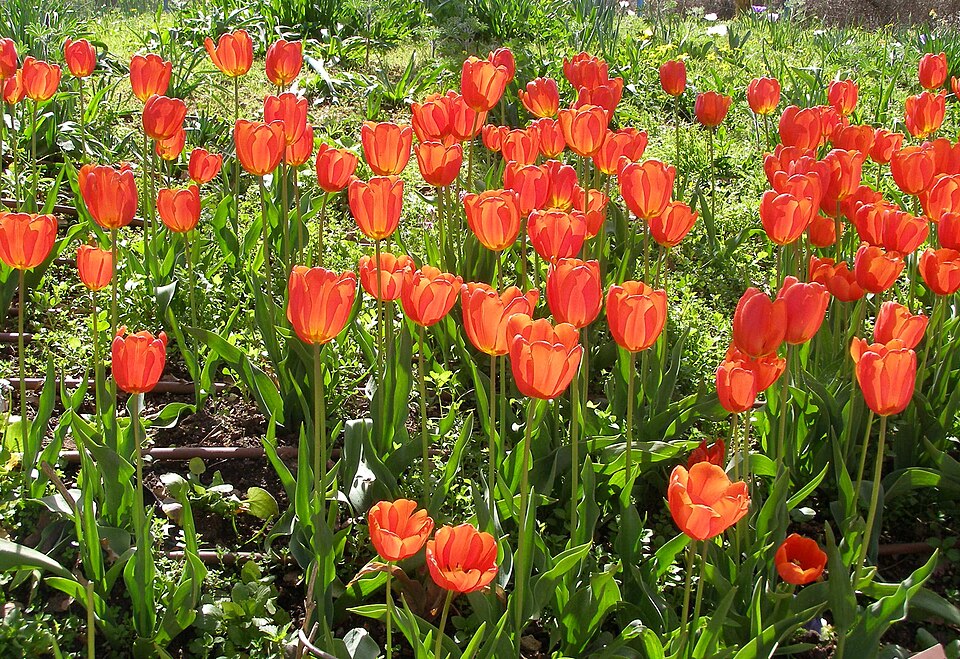
Tulips need 15 to 17 weeks of cold before they will flower on a full-length stem.
The facts in one table
| Climate band | Months | Sign on the plant |
|---|---|---|
| Northern hemisphere — cold and temperate winters | Sep · Oct · Nov | Plant about four weeks before the ground freezes, so roots form before winter |
| Southern hemisphere — cold and temperate winters | Mar · Apr · May | Plant about four weeks before the ground freezes, so roots form before winter |
| Northern hemisphere — warm winters, bulbs pre-chilled | Nov · Dec | Refrigerate from purchase and plant once the soil has cooled |
| Southern hemisphere — warm winters, bulbs pre-chilled | May · Jun | Refrigerate from purchase and plant once the soil has cooled |
Sources written in the northern hemisphere give northern months. The southern row is the same job shifted by six months, which is an approximation of the season — the sign on the plant is what you should actually act on.
Sources: University of Minnesota Extension · Clemson Cooperative Extension (HGIC) · Royal Horticultural Society
The chilling requirement is the real constraint
A tulip bulb will not flower properly without a long cold period. Extension guidance puts the requirement for most spring bulbs at 12 to 16 weeks of chilling, and for tulips specifically at 15 to 17 weeks, with an optimal chilling temperature between 40 and 45°F — roughly 4 to 7°C. Autumn planting is simply the way a garden delivers that, free of charge, over winter.
What happens without enough cold is recognisable: Clemson Extension notes that when bulbs do not receive enough chilling they bloom close to the ground on very short stems. That is the diagnostic for a mild-winter garden, and it is also the reason tulips are often treated as annuals in warm regions rather than as perennials.
Sources: Clemson Cooperative Extension (HGIC) · University of Minnesota Extension
Warm winters: chill the bulbs yourself
Where winters do not supply the cold, the bulbs have to be chilled artificially. For central and coastal South Carolina, Clemson Extension's guidance is to refrigerate bulbs from the time of purchase until planting in November to late December — the planting window moves later because the soil has to cool first and because the fridge is doing the work the ground would otherwise do.
This is the single most useful thing to know for anyone gardening in a mild climate and wondering why their tulips were disappointing. It is not the planting depth and usually not the variety; it is that the bulb never got its 15 to 17 weeks of cold.
Southern hemisphere, same logic
The published months — September to November — are northern-hemisphere autumn. South of the equator the equivalent falls around March to May, which is what the southern rows in the table show. The logic transfers exactly even though the month does not: plant while the bulb is dormant, late enough that the soil has cooled, early enough that roots form before the coldest weather.
In regions whose winters are too mild to supply 15 to 17 weeks near 4 to 7°C, the southern-hemisphere answer is the same as the mild-winter northern one: pre-chill the bulbs and accept that tulips may behave as annuals.
Sources: Clemson Cooperative Extension (HGIC) · Royal Horticultural Society · University of Minnesota Extension
Plant: Tulip (Tulipa spp.)
The bulb needs a long cold period before it will flower properly. Timing is about delivering that cold, not about a date.
| Climate band | Months | Sign on the plant |
|---|---|---|
| Northern hemisphere — cold and temperate winters | Sep · Oct · Nov | Plant about four weeks before the ground freezes, so roots form before winter |
| Southern hemisphere — cold and temperate winters | Mar · Apr · May | Plant about four weeks before the ground freezes, so roots form before winter |
| Northern hemisphere — warm winters, bulbs pre-chilled | Nov · Dec | Refrigerate from purchase and plant once the soil has cooled |
| Southern hemisphere — warm winters, bulbs pre-chilled | May · Jun | Refrigerate from purchase and plant once the soil has cooled |
Sources: University of Minnesota Extension · Clemson Cooperative Extension (HGIC) · Royal Horticultural Society
What most people get wrong
- "Plant bulbs in spring." Spring-flowering bulbs are planted in autumn while dormant; the cold of winter is part of the process, not an obstacle.
- "Short stems mean poor bulbs." Clemson links blooming close to the ground on very short stems to insufficient chilling.
- "It is too late once the frosts start." For tulips specifically, extension guidance says they can go in as late as you can get them into the soil.
- "Tulips come back forever." In mild-winter regions they often do not, because they cannot get the 15 to 17 weeks of cold they need.
Sources: University of Minnesota Extension · Clemson Cooperative Extension (HGIC)
Frequently asked questions
- What month should I plant tulip bulbs?
- September to October is the best window in temperate areas, before the first frost and about four weeks before the ground freezes. In the southern hemisphere the equivalent is around March to May.
- How much cold do tulips need?
- Extension guidance gives 15 to 17 weeks of chilling for tulips, with an optimal chilling temperature of 40 to 45°F, roughly 4 to 7°C.
- What if my winters are mild?
- Refrigerate the bulbs from purchase and plant later — Clemson Extension gives November to late December for central and coastal South Carolina.
How to read the numbers
The numbers on “When to plant tulip bulbs” come from the facts table at the top, with the official source alongside.
Where the data comes from
Each section of “When to plant tulip bulbs” names its source (agency, university or breed club) with a verification date.
What this page doesn’t replace
Educational information, not a substitute for a vet, agronomist or specialist assessing your specific case.
More about this page
The Tulip (Tulipa spp.) calendar changes with the hemisphere
Planting Tulip (Tulipa spp.) has 4 windows recorded here, split between the northern and southern hemisphere — because February in Brazil is August in Europe, and copying the month from a guide written for the wrong hemisphere rushes or delays the plant.
Words on this page
Formative pruning vs. maintenance pruning
Formative pruning happens in a plant’s first years and sets the permanent shape of the main branches; maintenance pruning is yearly, removes dead, diseased or crossing branches, and does not change the plant’s architecture. Mixing the two up is the most common reason a fruit tree fails to bear fruit.
Dormancy
The period when a plant slows its metabolism and stops visible growth, usually in autumn and winter, to survive cold or drought. Pruning, transplanting or fertilising during dormancy is usually less stressful for the plant than doing it in full growth.
Hardiness zone
A numbered band that ranks a region by the average coldest winter temperature it reaches, used to tell whether a plant survives there outdoors. The reference system is the US one (USDA), from zone 1, coldest, to 13, warmest.
Standard definition by USDA — Agricultural Research Service, Plant Hardiness Zone Map · Hardiness zone
Hemisphere
Half of the globe split by the equator. The seasons flip between the two: when it is winter in the northern hemisphere, it is summer in the southern one, which shifts the pruning, bloom and harvest calendar described on this page.
Life cycle
The sequence of stages an organism passes through from birth to death — for an animal, young, adult and senior; for a plant, germination, growth, flowering and, in annuals, death after setting seed.
Toxicity
A plant’s or substance’s capacity to harm an organism, which varies with the species exposed, the amount ingested and the animal’s size. A plant "toxic to dogs" is not necessarily toxic to humans at the same dose, and the reverse holds too.
Standard definition by ASPCA — Animal Poison Control Center · Toxicity
Sources
- Planting bulbs, tubers and rhizomes — University of Minnesota Extension. Checked on 2026-10-07.
- Spring-Flowering Bulbs — Clemson Cooperative Extension (HGIC). Checked on 2026-10-07.
- How to grow tulips — Royal Horticultural Society. Checked on 2026-10-07.