When to plant potatoes
Early spring, as soon as the ground can be worked — extension guidance allows planting up to two weeks before the frost-free date, which makes potatoes one of the earliest crops of the year. The number that matters is soil temperature: plant when the soil warms to 45°F, about 7°C, because planting into soil that is too cold or too wet increases the chance of the seed potato rotting.
Updated on 2026-10-07.
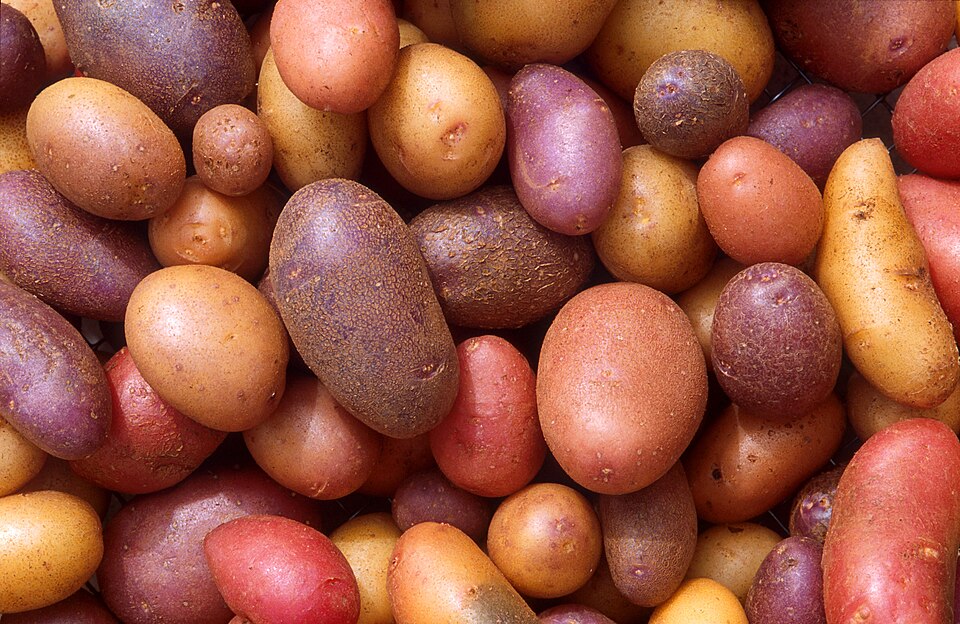
Potato (Solanum tuberosum): planted into cool soil so the crop bulks before summer heat.
The facts in one table
| Climate band | Months | Sign on the plant |
|---|---|---|
| Northern hemisphere — cold and temperate, as soon as the soil can be worked | Mar · Apr | Soil reaches 45°F (about 7°C) and is workable, not waterlogged |
| Southern hemisphere — cold and temperate, as soon as the soil can be worked | Sep · Oct | Soil reaches 45°F (about 7°C) and is workable, not waterlogged |
| Soil temperature to plant | 45°F / about 7°C | Soil crumbles rather than smears; below this the seed potato rots |
| Soil temperature to bulk | 60–70°F | Tuber growth is optimal in this range and ceases at about 80°F |
| Relative to the frost-free date | Up to two weeks earlier | The seed piece is underground; emerged foliage is not frost hardy |
Sources written in the northern hemisphere give northern months. The southern row is the same job shifted by six months, which is an approximation of the season — the sign on the plant is what you should actually act on.
Sources: University of Minnesota Extension · University of Illinois Extension · University of Illinois Extension
Two numbers: 45°F to plant, 60–70°F to grow
Potatoes tolerate cool soil at planting far better than warm-season crops, which is why they go in early. Extension guidance gives 45°F as the planting threshold, and the reason to respect it is specific: cold, wet soil rots seed potatoes rather than sprouting them. Workable soil — crumbling rather than smearing — is the second half of the same test.
Growing is a different range. Optimal tuber growth happens at soil temperatures between 60 and 70°F, and growth ceases at about 80°F. That is the actual argument for planting early: you are trying to get the crop's bulking phase into the cool part of the season before summer heat shuts it down. In central Illinois that means late March or early April.
Sources: University of Minnesota Extension · University of Illinois Extension
Seed potatoes, not supermarket potatoes
Extension guidance is to buy certified seed potatoes that are disease free, available from garden centres in spring. The reason is that potatoes carry viral and fungal problems from one generation to the next, and certification is the mechanism that keeps them out of your soil. Supermarket potatoes are grown for eating, not inspected for this, and are often treated to suppress sprouting.
Spacing from the same guidance: rows 30 to 36 inches apart, seed pieces 10 to 12 inches apart within the row, about 4 inches deep. The depth is worth getting right because it affects how much the tubers need earthing up later to stay out of the light.
Sources: University of Minnesota Extension · University of Illinois Extension
Which months, and where
The published months are northern-hemisphere ones — late March and early April for the US Midwest — which the table shifts by six months for the southern hemisphere, landing around September and October. As with everything in this family, the shift is an approximation of the season and the condition is what travels: 45°F in workable soil, whatever the month is called where you are.
The frost caveat applies in both hemispheres. Planting up to two weeks before the frost-free date is tolerable because the seed piece is underground; emerged foliage is not frost hardy, so a late frost after the shoots are up means covering them or losing growth.
Sources: University of Illinois Extension · University of Minnesota Extension
Plant: Potato (Solanum tuberosum)
A soil thermometer is a better guide than the calendar: 45°F and workable soil is the condition, whatever the date.
| Climate band | Months | Sign on the plant |
|---|---|---|
| Northern hemisphere — cold and temperate, as soon as the soil can be worked | Mar · Apr | Soil reaches 45°F (about 7°C) and is workable, not waterlogged |
| Southern hemisphere — cold and temperate, as soon as the soil can be worked | Sep · Oct | Soil reaches 45°F (about 7°C) and is workable, not waterlogged |
Sources: University of Minnesota Extension · University of Illinois Extension
What most people get wrong
- "Wait until after the last frost." Potatoes can go in up to two weeks before the frost-free date, because the seed piece is underground.
- "Earlier is always better." Below 45°F, or in waterlogged soil, the seed potato rots instead of sprouting.
- "Supermarket potatoes work fine as seed." Extension guidance is to use certified disease-free seed potatoes.
- "Potatoes like heat." Optimal tuber growth is at 60 to 70°F soil temperature and stops at about 80°F.
Sources: University of Minnesota Extension · University of Illinois Extension
Frequently asked questions
- What soil temperature do potatoes need to be planted?
- 45°F, about 7°C, and the soil should be workable rather than wet — colder or wetter and the seed potato is likely to rot.
- Can I plant potatoes before the last frost?
- Yes, up to about two weeks before the frost-free date, as long as the ground can be worked. Emerged foliage will still need protecting from a late frost.
- What month are potatoes planted?
- Late March or early April in the US Midwest; earlier in milder regions and later in colder ones. In the southern hemisphere the equivalent falls around September and October.
How to read the numbers
The numbers on “When to plant potatoes” come from the facts table at the top, with the official source alongside.
Where the data comes from
Each section of “When to plant potatoes” names its source (agency, university or breed club) with a verification date.
What this page doesn’t replace
Educational information, not a substitute for a vet, agronomist or specialist assessing your specific case.
More about this page
The Potato (Solanum tuberosum) calendar changes with the hemisphere
Planting Potato (Solanum tuberosum) has 2 windows recorded here, split between the northern and southern hemisphere — because February in Brazil is August in Europe, and copying the month from a guide written for the wrong hemisphere rushes or delays the plant.
Words on this page
Formative pruning vs. maintenance pruning
Formative pruning happens in a plant’s first years and sets the permanent shape of the main branches; maintenance pruning is yearly, removes dead, diseased or crossing branches, and does not change the plant’s architecture. Mixing the two up is the most common reason a fruit tree fails to bear fruit.
Dormancy
The period when a plant slows its metabolism and stops visible growth, usually in autumn and winter, to survive cold or drought. Pruning, transplanting or fertilising during dormancy is usually less stressful for the plant than doing it in full growth.
Hardiness zone
A numbered band that ranks a region by the average coldest winter temperature it reaches, used to tell whether a plant survives there outdoors. The reference system is the US one (USDA), from zone 1, coldest, to 13, warmest.
Standard definition by USDA — Agricultural Research Service, Plant Hardiness Zone Map · Hardiness zone
Hemisphere
Half of the globe split by the equator. The seasons flip between the two: when it is winter in the northern hemisphere, it is summer in the southern one, which shifts the pruning, bloom and harvest calendar described on this page.
Life cycle
The sequence of stages an organism passes through from birth to death — for an animal, young, adult and senior; for a plant, germination, growth, flowering and, in annuals, death after setting seed.
Hypoallergenic
A term used for breeds that shed less allergen into the environment, usually because they shed less fur. No dog or cat breed is fully allergen-free: a cat’s main allergen comes from saliva and skin, not only fur, and a very sensitive person can react to any breed.
Standard definition by American Kennel Club · Hypoallergenic
Sources
- Growing potatoes in home gardens — University of Minnesota Extension. Checked on 2026-10-07.
- Potatoes — Illinois Vegetable Garden Guide — University of Illinois Extension. Checked on 2026-10-07.
- When to Plant — University of Illinois Extension. Checked on 2026-10-07.