When to harvest garlic
Not on a date, on the leaves. University extension guidance is consistent: start harvesting when the lower leaves turn brown while half or slightly more than half of the upper leaves are still green — in practice, the top four to five leaves green with the rest browning off. Depending on variety and climate zone that falls between late June and late July in the northern hemisphere, and around December and January south of the equator.
Updated on 2026-10-07.
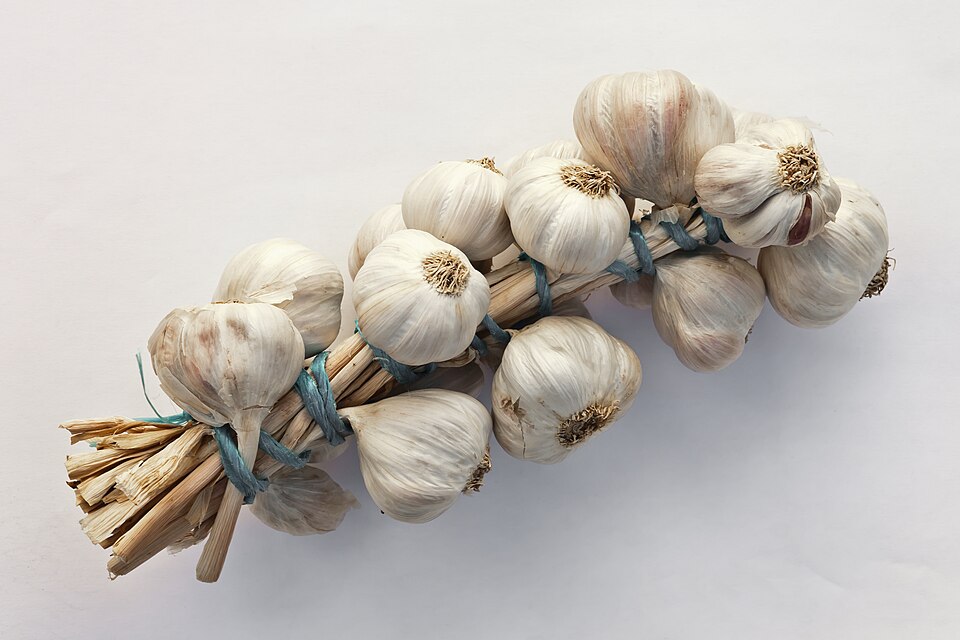
Garlic (Allium sativum): each green leaf at harvest is one more intact wrapper on the bulb.
The facts in one table
| Climate band | Months | Sign on the plant |
|---|---|---|
| Northern hemisphere — cold and temperate, autumn-planted | Jun · Jul | The lower leaves have turned brown while the top four or five are still green |
| Southern hemisphere — cold and temperate, autumn-planted | Dec · Jan | The lower leaves have turned brown while the top four or five are still green |
| Northern hemisphere — planting window, for reference | Sep · Oct · Nov | Plant in autumn, before the ground freezes |
| Southern hemisphere — planting window, for reference | Mar · Apr · May | Plant in autumn, before the ground freezes |
Sources written in the northern hemisphere give northern months. The southern row is the same job shifted by six months, which is an approximation of the season — the sign on the plant is what you should actually act on.
Sources: University of Minnesota Extension · University of Minnesota Extension · Penn State Extension
Why the leaves are the clock
Each leaf on a garlic plant corresponds to a wrapper layer around the bulb underground. As the season ends the lower leaves die back from the bottom up, and with them the outer wrappers. Harvesting while the top four or five leaves are still green means the bulb still has intact wrappers — which is what lets it cure properly and keep for months.
The two failure modes are symmetrical and both specific. Extension guidance states them bluntly: harvesting too early gives small bulbs, and harvesting too late means the cloves pop out of the bulb because the wrappers that held them together have gone. The window between the two is a matter of a week or two, which is why a date on a calendar is a poor substitute for looking.
Sources: University of Minnesota Extension · Penn State Extension
Scapes come first
Hardneck varieties send up a flowering stalk, the scape, several weeks before harvest. Extension guidance is to remove scapes just after they start curling — and to eat them, because they are good. Harvesting them before they straighten and stiffen is the quality point for eating; removing them at all is usually credited with sending more of the plant's energy into the bulb.
The scape is also a useful marker in the season. Once scapes appear, harvest is weeks rather than months away, and it is time to start checking the lower leaves rather than waiting for the whole plant to collapse.
Sources: University of Minnesota Extension · Penn State Extension
Curing, and why it is not optional
A freshly lifted bulb is not storage garlic yet. Extension guidance is to put the whole plants somewhere warm, dry and airy for three to four weeks to cure, which dries the sheaths around the bulb along with the shoots and roots. Only after curing is complete should the roots and stalks be trimmed — cutting them first opens the bulb up to rot.
The planting end of the cycle is worth knowing because it decides the harvest. Garlic is planted in autumn in cold and temperate climates, going into the ground before it freezes so the clove roots out and overwinters; the following summer's bulb size is largely decided by how well that autumn establishment went.
Sources: University of Minnesota Extension · Penn State Extension
Harvest: Garlic (Allium sativum)
Each green leaf corresponds to a wrapper around the bulb. Harvest too late and those wrappers have already rotted away.
| Climate band | Months | Sign on the plant |
|---|---|---|
| Northern hemisphere — cold and temperate, autumn-planted | Jun · Jul | The lower leaves have turned brown while the top four or five are still green |
| Southern hemisphere — cold and temperate, autumn-planted | Dec · Jan | The lower leaves have turned brown while the top four or five are still green |
| Northern hemisphere — planting window, for reference | Sep · Oct · Nov | Plant in autumn, before the ground freezes |
| Southern hemisphere — planting window, for reference | Mar · Apr · May | Plant in autumn, before the ground freezes |
Sources: University of Minnesota Extension · University of Minnesota Extension · Penn State Extension
What most people get wrong
- "Wait until all the leaves have died." By then the wrappers have gone and the cloves separate — extension guidance warns that harvesting too late makes cloves pop out of the bulb.
- "Harvest on a fixed date." The window moves with variety and climate zone; extension guidance gives late June to late July and tells you to read the leaves.
- "Trim the roots and tops straight away." Only after three to four weeks of curing; trimming first exposes the bulb.
- "Scapes are a nuisance." They are food. Cut them just after they start curling, before they straighten and stiffen.
Sources: University of Minnesota Extension · Penn State Extension
Frequently asked questions
- How do I know when garlic is ready?
- When the lower leaves have turned brown and about the top four or five leaves are still green. That means the bulb still has intact wrappers for curing and storage.
- What month is garlic harvested?
- Between late June and late July in the northern hemisphere, depending on variety and climate zone — mid-July in Minnesota, for example. South of the equator the equivalent falls around December and January.
- How long does garlic need to cure?
- Three to four weeks in a warm, dry, airy place, with the roots and stalks trimmed only once curing is complete.
How to read the numbers
The numbers on “When to harvest garlic” come from the facts table at the top, with the official source alongside.
Where the data comes from
Each section of “When to harvest garlic” names its source (agency, university or breed club) with a verification date.
What this page doesn’t replace
Educational information, not a substitute for a vet, agronomist or specialist assessing your specific case.
More about this page
The Garlic (Allium sativum) calendar changes with the hemisphere
Harvesting Garlic (Allium sativum) has 4 windows recorded here, split between the northern and southern hemisphere — because February in Brazil is August in Europe, and copying the month from a guide written for the wrong hemisphere rushes or delays the plant.
Words on this page
Formative pruning vs. maintenance pruning
Formative pruning happens in a plant’s first years and sets the permanent shape of the main branches; maintenance pruning is yearly, removes dead, diseased or crossing branches, and does not change the plant’s architecture. Mixing the two up is the most common reason a fruit tree fails to bear fruit.
Dormancy
The period when a plant slows its metabolism and stops visible growth, usually in autumn and winter, to survive cold or drought. Pruning, transplanting or fertilising during dormancy is usually less stressful for the plant than doing it in full growth.
Hardiness zone
A numbered band that ranks a region by the average coldest winter temperature it reaches, used to tell whether a plant survives there outdoors. The reference system is the US one (USDA), from zone 1, coldest, to 13, warmest.
Standard definition by USDA — Agricultural Research Service, Plant Hardiness Zone Map · Hardiness zone
Hemisphere
Half of the globe split by the equator. The seasons flip between the two: when it is winter in the northern hemisphere, it is summer in the southern one, which shifts the pruning, bloom and harvest calendar described on this page.
Life cycle
The sequence of stages an organism passes through from birth to death — for an animal, young, adult and senior; for a plant, germination, growth, flowering and, in annuals, death after setting seed.
Hypoallergenic
A term used for breeds that shed less allergen into the environment, usually because they shed less fur. No dog or cat breed is fully allergen-free: a cat’s main allergen comes from saliva and skin, not only fur, and a very sensitive person can react to any breed.
Standard definition by American Kennel Club · Hypoallergenic
Sources
- Growing garlic in home gardens — University of Minnesota Extension. Checked on 2026-10-07.
- Garlic harvest is mid July in Minnesota — University of Minnesota Extension. Checked on 2026-10-07.
- Growing and Using Garlic — Penn State Extension. Checked on 2026-10-07.