Largest cat breeds
The Cat Fanciers' Association settles the top of the list: the Maine Coon is described on its own CFA page as the largest of all pedigreed cats, and the association notes that it is not unusual for a mature male's weight to reach or exceed 20 pounds — about 9 kg — with females usually smaller. The Ragdoll is described in the same terms. Below them come the Siberian, where the CFA gives 12 to 18 pounds for a mature male, and the Norwegian Forest Cat at 12 to 16 pounds.
Updated on 2026-10-07.
Breed-level figures describe populations, not the animal in front of you. For anything about a specific cat's health or care, consult a veterinarian.
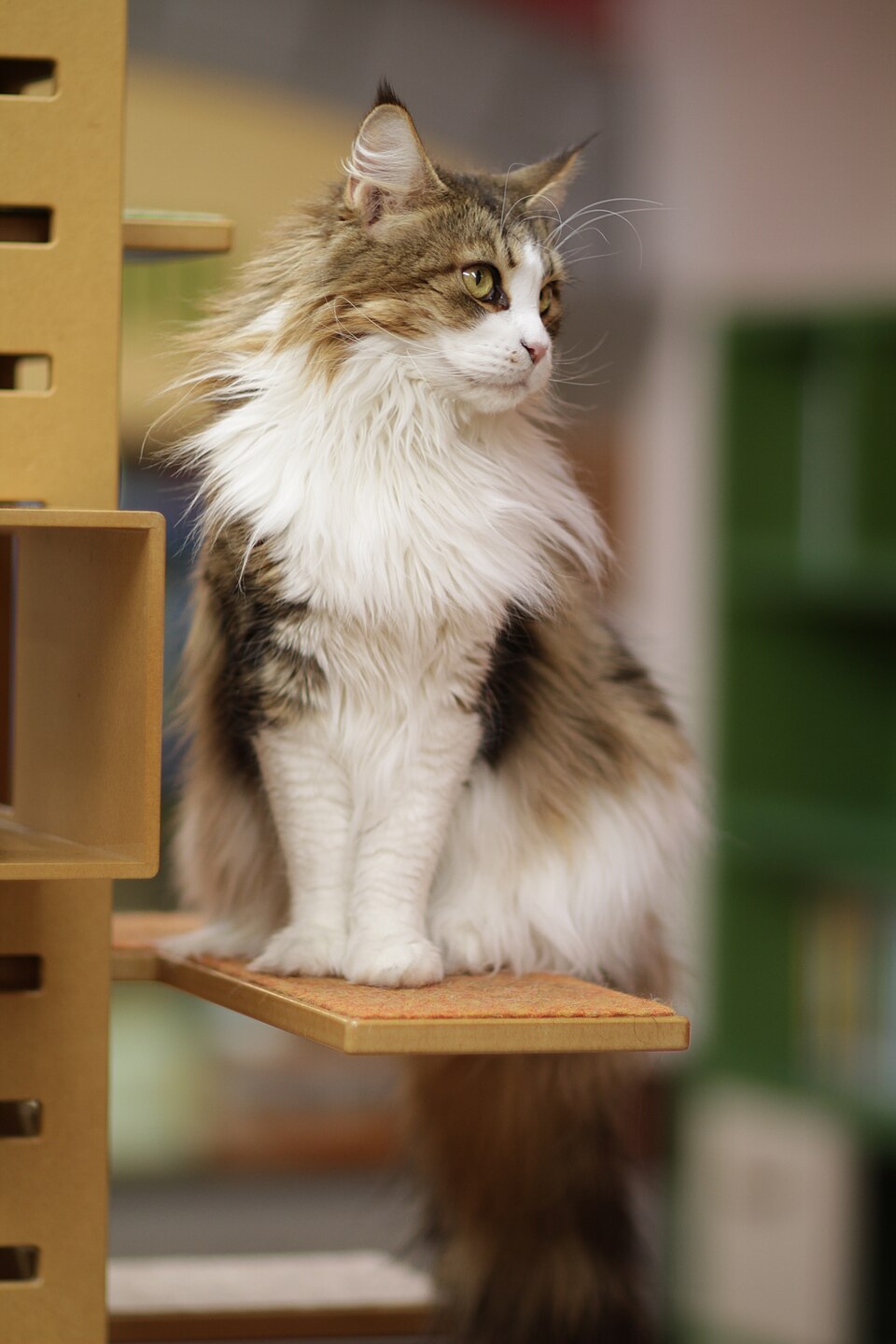
Maine Coon: described by the CFA as the largest of all pedigreed cats.
The facts in one table
| Breed | Weight | Coat | Size |
|---|---|---|---|
| Maine Coon | ≥ 9 kg | long | large |
| Ragdoll | ≥ 9 kg | long | large |
| Siberian | 3.6–8.2 kg | long | large |
| Norwegian Forest Cat | 4.1–7.3 kg | long | large |
| British Shorthair | — | short | medium |
| Bengal | — | short | medium |
Adult weights as published on the CFA breed pages. Where the CFA phrases the figure as "a mature male may reach or exceed" a weight, the table shows it as a floor for males (≥).
Sources: Cat Fanciers' Association · Cat Fanciers' Association · Guinness World Records
How big a Maine Coon actually gets
The CFA breed standard describes the Maine Coon body as muscular and broad-chested, of medium to large size, long with all parts in proportion to create a well-balanced rectangular appearance — and it adds the warning that no part of the anatomy should be so exaggerated as to foster weakness. That last clause is the part breeders care about and the internet ignores: the standard asks for a big, balanced cat, not the biggest possible cat.
Growth is slow. The CFA notes this is a slow-maturing breed that can take up to three years to reach full growth, which is why a one-year-old Maine Coon is not a reliable guide to its adult size. Length records give a sense of the extreme: Guinness World Records lists the longest domestic cat ever as Stewie, a Maine Coon measuring 123 cm from nose to tail tip, with Barivel at 120 cm among later record holders.
Sources: Cat Fanciers' Association · Guinness World Records
The other big breeds, and the maturing problem
The large breeds share an awkward trait for buyers: they all take years to finish. The CFA calls the Siberian one of the slowest-maturing cat breeds, most reaching full size by three years, at 12 to 18 pounds for a mature male and 8 to 12 pounds for a female. The Norwegian Forest Cat can take up to five years to reach full growth, ending at 12 to 16 pounds for a male and 9 to 12 for a female. Ragdolls reach full coat colour at two years and full size and weight at four.
That has a practical consequence. A kitten sold as a large breed looks like any other kitten, and the size you were promised arrives years later or does not. The weights above are the published figures to hold a breeder to, and they are also a warning against assuming a heavier cat is a better example of the breed.
Sources: Cat Fanciers' Association · Cat Fanciers' Association
Large breed, or just a heavy cat?
The most common mistake with these breeds is reading weight as size. A nine-kilogram Maine Coon with a broad frame and the rectangular body the standard asks for is a large cat; a nine-kilogram cat of any breed carrying too much weight is a different situation entirely, and the CFA standard's insistence on proportion is the relevant point. Body condition is assessed by feel and shape, not by the number on a scale, and it is a question for a veterinarian rather than a breed page.
Breed-level figures describe populations, not the animal in front of you. For anything about a specific cat's health or care, consult a veterinarian.
Source: Cat Fanciers' Association
What most people get wrong
- "The record Maine Coons show what the breed should look like." The CFA standard explicitly rejects exaggeration that would foster weakness.
- "A big kitten means a big cat." These breeds take three to five years to finish growing, so kitten size predicts very little.
- "Savannahs and other hybrids are the biggest breeds." The CFA names the Maine Coon as the largest of all pedigreed cats.
- "Heavier is more impressive." Weight without the frame to carry it is a body-condition question, not a breed trait.
Sources: Cat Fanciers' Association · Cat Fanciers' Association
Frequently asked questions
- What is the largest cat breed?
- The Maine Coon. Its CFA page describes it as the largest of all pedigreed cats, with mature males not unusually reaching or exceeding 20 pounds, about 9 kg.
- How big does a Maine Coon get?
- The CFA gives mature males reaching or exceeding 20 pounds (about 9 kg), with females usually smaller, and notes the breed can take up to three years to reach full growth.
- What is the longest cat ever recorded?
- Guinness World Records lists Stewie, a Maine Coon, at 123 cm from nose to tail tip; Barivel, also a Maine Coon, was later measured at 120 cm.
How to read the numbers
The numbers on “Largest cat breeds” come from the facts table at the top, with the official source alongside.
Where the data comes from
Each section of “Largest cat breeds” names its source (agency, university or breed club) with a verification date.
What this page doesn’t replace
Educational information, not a substitute for a vet, agronomist or specialist assessing your specific case.
Go deeper at the official source
To go deeper than “Largest cat breeds”, the source named below publishes the original document.
Words on this page
Hypoallergenic
A term used for breeds that shed less allergen into the environment, usually because they shed less fur. No dog or cat breed is fully allergen-free: a cat’s main allergen comes from saliva and skin, not only fur, and a very sensitive person can react to any breed.
Standard definition by American Kennel Club · Hypoallergenic
Life cycle
The sequence of stages an organism passes through from birth to death — for an animal, young, adult and senior; for a plant, germination, growth, flowering and, in annuals, death after setting seed.
Toxicity
A plant’s or substance’s capacity to harm an organism, which varies with the species exposed, the amount ingested and the animal’s size. A plant "toxic to dogs" is not necessarily toxic to humans at the same dose, and the reverse holds too.
Standard definition by ASPCA — Animal Poison Control Center · Toxicity
Hemisphere
Half of the globe split by the equator. The seasons flip between the two: when it is winter in the northern hemisphere, it is summer in the southern one, which shifts the pruning, bloom and harvest calendar described on this page.
Hardiness zone
A numbered band that ranks a region by the average coldest winter temperature it reaches, used to tell whether a plant survives there outdoors. The reference system is the US one (USDA), from zone 1, coldest, to 13, warmest.
Standard definition by USDA — Agricultural Research Service, Plant Hardiness Zone Map · Hardiness zone
Formative pruning vs. maintenance pruning
Formative pruning happens in a plant’s first years and sets the permanent shape of the main branches; maintenance pruning is yearly, removes dead, diseased or crossing branches, and does not change the plant’s architecture. Mixing the two up is the most common reason a fruit tree fails to bear fruit.
Sources
- Maine Coon Cat — Cat Fanciers' Association. Checked on 2026-10-07.
- Breeds — Cat Fanciers' Association. Checked on 2026-10-07.
- Longest domestic cat ever — Guinness World Records. Checked on 2026-10-07.