Cat breeds list
There are far fewer cat breeds than dog breeds, and the gap is not an accident: cats were not selectively bred into working types for thousands of years the way dogs were, so most of the recognised breeds are recent and the differences between them are mostly coat, colour and build rather than function. Registries each recognise their own list, which is why totals differ. Below are the sixteen breeds covered on this site, with the figures the Cat Fanciers' Association publishes.
Updated on 2026-10-07.
Breed-level figures describe populations, not the animal in front of you. For anything about a specific cat's health or care, consult a veterinarian.
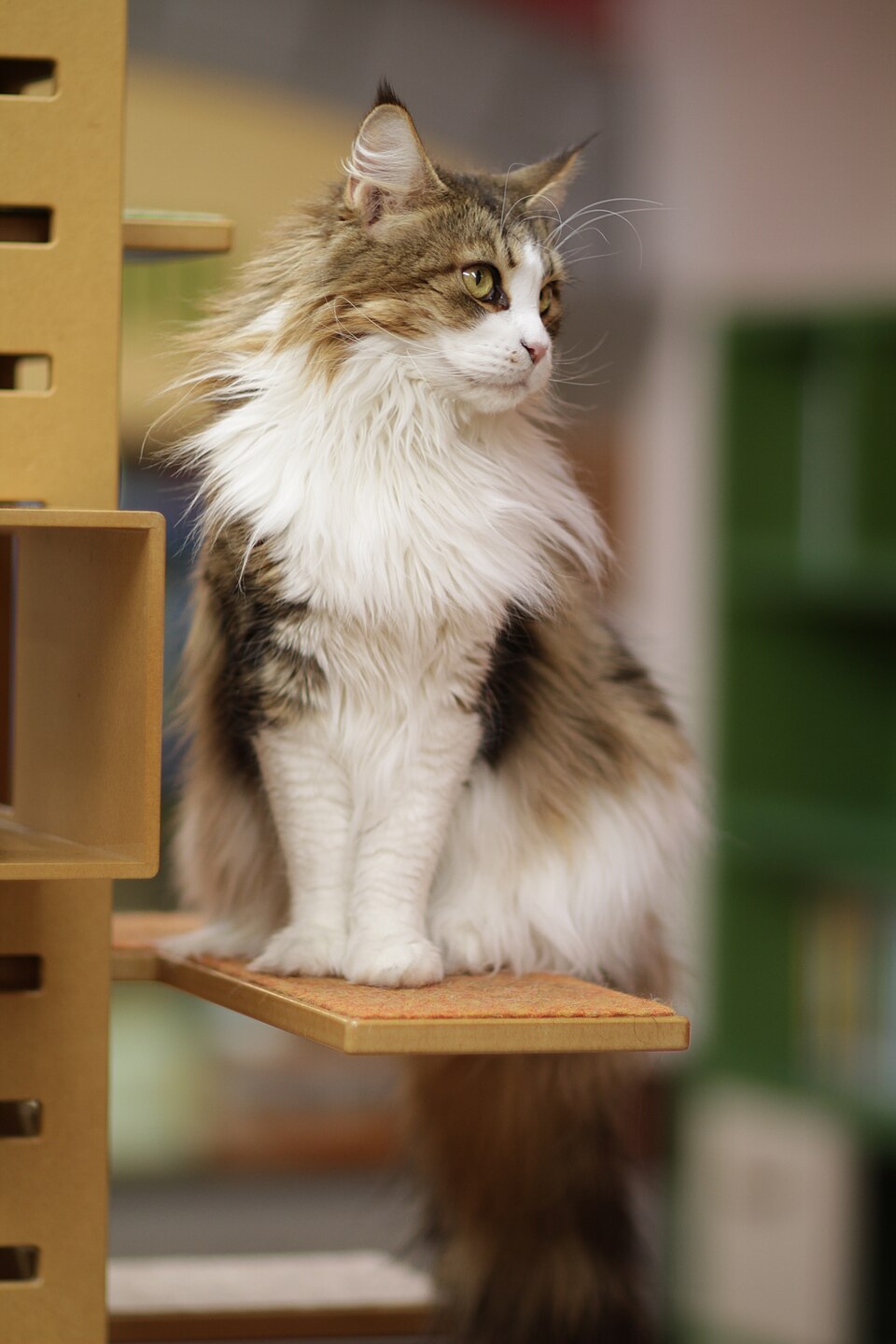
Long-coated breeds need combing; the near-hairless breeds trade that for regular bathing.
The facts in one table
| Breed | Coat | Shedding | Weight | Life expectancy |
|---|---|---|---|---|
| Maine Coon | long | high | ≥ 9 kg | — |
| Ragdoll | long | moderate | ≥ 9 kg | — |
| Norwegian Forest Cat | long | high | 4.1–7.3 kg | — |
| Siberian | long | high | 3.6–8.2 kg | — |
| Persian | long | high | — | — |
| Birman | long | moderate | — | 14.4 years |
| British Shorthair | short | high | — | — |
| Siamese | short | moderate | — | 11.7 years |
| Oriental | short | moderate | — | — |
| Abyssinian | short | low | — | — |
| Burmese | short | low | ≥ 5.4 kg | 14.4 years |
| Russian Blue | short | moderate | 2.3–4.5 kg | — |
| Bengal | short | low | — | — |
| Devon Rex | curly | low | 2.7–4.1 kg | — |
| Cornish Rex | curly | low | — | — |
| Sphynx | nearly hairless | low | — | 6.8 years |
Coat and adult weight from the CFA breed pages; life expectancy at birth from the VetCompass UK cat life tables for the four breeds that study reports.
Sources: Cat Fanciers' Association · Royal Veterinary College — VetCompass
Why there are so few cat breeds
Dogs were shaped for jobs — herding, guarding, retrieving, pulling, hunting by scent or sight — and each job produced a body. Cats had one job, and it did not require a redesign: a cat that hunts rodents around a settlement is already the right animal. Almost all selective breeding of cats is recent and aesthetic, which is why the recognised breeds cluster around coat length, coat texture, colour pattern and head shape.
The consequence for anyone comparing breeds is that temperament differences between cat breeds are smaller and less documented than between dog breeds. Registry breed pages describe personality in general terms, and there is nothing equivalent to the functional groups a kennel club uses for dogs.
Source: Cat Fanciers' Association
What actually differs between the breeds
Coat is the first real split, and it is the one that changes daily life. The CFA classifies breeds by coat length, and the long-coated breeds — Maine Coon, Ragdoll, Norwegian Forest Cat, Siberian, Persian, Birman — need combing to control shedding, prevent hairballs and stop matting, which the CFA says breeders recommend for the Maine Coon specifically. The curly and near-hairless breeds sit at the other end: the Cornish Rex has no outer guard hairs, the Sphynx is described as the "hairless" cat.
Size is the second, and it is narrower than people expect. Across the recognised breeds, published adult weights run roughly from the Russian Blue, where the CFA notes males rarely exceed 10 pounds, to the Maine Coon and Ragdoll, where mature males may reach or exceed 20 pounds. That is a factor of two, where dogs span a factor of forty.
Sources: Cat Fanciers' Association · Cat Fanciers' Association
The one hard number: how long they live
The VetCompass study of 7,936 UK cats that died between 2019 and 2021 is the best measurement available, and it does report by breed for a few. Burmese and Birman come out highest at 14.4 years of life expectancy at birth, followed by crossbreeds at 11.9 and Siamese at 11.7, against 11.74 years for cats overall. The Sphynx is the outlier at 6.8 years.
Those are the only four breeds in this table with a figure, and the rest of the column is deliberately empty. Publishing an estimate for the others would look more complete and mean less.
Sources: Royal Veterinary College — VetCompass · Royal Veterinary College
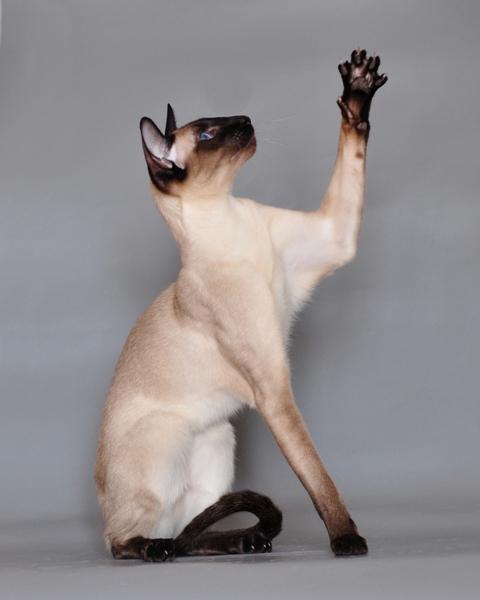
Siamese: life expectancy at birth of 11.7 years in the VetCompass UK study.
What most people get wrong
- "There are hundreds of cat breeds." Registries recognise far fewer than for dogs, and the totals differ between organisations.
- "Cat breeds differ in temperament the way dog breeds do." The differences are mostly coat, colour and build; temperament differences are smaller and much less documented.
- "Pedigree cats live longer." In the VetCompass data crossbreeds reach 11.9 years, above the Siamese at 11.7 and far above the Sphynx at 6.8.
Sources: Cat Fanciers' Association · Royal Veterinary College — VetCompass
Frequently asked questions
- How many cat breeds are there?
- It depends on the registry: each recognises its own list, and the totals are far lower than for dogs. This page covers sixteen of the best-known breeds.
- Which cat breed lives longest?
- Of the breeds measured in the VetCompass UK study, Burmese and Birman share the highest life expectancy at birth at 14.4 years.
- Which breeds need the most grooming?
- The long-coated ones. For the Maine Coon the CFA notes that breeders recommend combing to control shedding, prevent hairballs and protect against matting.
How to read the numbers
The numbers on “Cat breeds list” come from the facts table at the top, with the official source alongside.
Where the data comes from
Each section of “Cat breeds list” names its source (agency, university or breed club) with a verification date.
What this page doesn’t replace
Educational information, not a substitute for a vet, agronomist or specialist assessing your specific case.
Go deeper at the official source
To go deeper than “Cat breeds list”, the source named below publishes the original document.
Words on this page
Hypoallergenic
A term used for breeds that shed less allergen into the environment, usually because they shed less fur. No dog or cat breed is fully allergen-free: a cat’s main allergen comes from saliva and skin, not only fur, and a very sensitive person can react to any breed.
Standard definition by American Kennel Club · Hypoallergenic
Life cycle
The sequence of stages an organism passes through from birth to death — for an animal, young, adult and senior; for a plant, germination, growth, flowering and, in annuals, death after setting seed.
Toxicity
A plant’s or substance’s capacity to harm an organism, which varies with the species exposed, the amount ingested and the animal’s size. A plant "toxic to dogs" is not necessarily toxic to humans at the same dose, and the reverse holds too.
Standard definition by ASPCA — Animal Poison Control Center · Toxicity
Hemisphere
Half of the globe split by the equator. The seasons flip between the two: when it is winter in the northern hemisphere, it is summer in the southern one, which shifts the pruning, bloom and harvest calendar described on this page.
Hardiness zone
A numbered band that ranks a region by the average coldest winter temperature it reaches, used to tell whether a plant survives there outdoors. The reference system is the US one (USDA), from zone 1, coldest, to 13, warmest.
Standard definition by USDA — Agricultural Research Service, Plant Hardiness Zone Map · Hardiness zone
Dormancy
The period when a plant slows its metabolism and stops visible growth, usually in autumn and winter, to survive cold or drought. Pruning, transplanting or fertilising during dormancy is usually less stressful for the plant than doing it in full growth.
Sources
- Breeds — Cat Fanciers' Association. Checked on 2026-10-07.
- Life tables of annual life expectancy and risk factors for mortality in cats in the UK (JFMS, 2024) — Royal Veterinary College — VetCompass. Checked on 2026-10-07. 7.936 gatos que morreram entre 1/1/2019 e 31/3/2021, sob atendimento veterinário primário no Reino Unido.
- Maine Coon Cat — Cat Fanciers' Association. Checked on 2026-10-07.
- New research from the RVC predicts the future life expectancy for companion cats — Royal Veterinary College. Checked on 2026-10-07.