Hypoallergenic cat breeds
There is no hypoallergenic cat, and the clearest statement of that comes from a cat registry rather than a sceptic: the Cat Fanciers' Association page for the Devon Rex says that contrary to popular belief, they are not hypoallergenic. The reason is Fel d 1, a protein produced mainly in a cat's salivary and sebaceous glands and spread over the fur by grooming. Every cat makes it, which is why the Asthma and Allergy Foundation of America states that a truly non-allergic dog or cat does not exist.
Updated on 2026-10-07.
Allergy is a medical matter. If someone in the household reacts to cats, testing and advice from an allergy specialist is the step that helps; for the animal itself, consult a veterinarian.
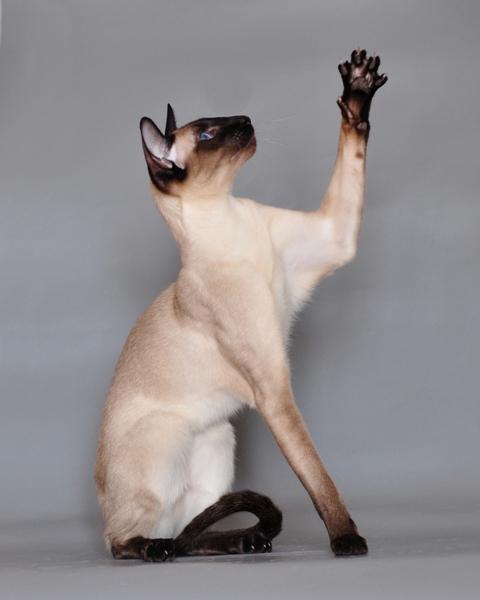
Short-coated breeds shed less carrier hair — but every cat produces Fel d 1.
The facts in one table
| Breed | Coat | Shedding | Weight | Life expectancy |
|---|---|---|---|---|
| Sphynx | nearly hairless | low | — | 6.8 years |
| Devon Rex | curly | low | 2.7–4.1 kg | — |
| Cornish Rex | curly | low | — | — |
| Siberian | long | high | 3.6–8.2 kg | — |
| Bengal | short | low | — | — |
| Burmese | short | low | ≥ 5.4 kg | 14.4 years |
| Oriental | short | moderate | — | — |
| Abyssinian | short | low | — | — |
Coat type and adult weight from the CFA breed pages; life expectancy at birth from the VetCompass UK cat life tables, where the study measured the breed.
Sources: Cat Fanciers' Association · Royal Veterinary College — VetCompass · PMC / National Library of Medicine
Fel d 1: where the allergen comes from
Fel d 1 is a glycoprotein produced mainly in the sebaceous, salivary and anal glands. During grooming, saliva carrying it is deposited on the fur and skin, from where it dries, becomes airborne and is released continuously into the room. That pathway is the whole story: the allergen does not originate in hair, hair carries it. AAFA puts the same point from the human side, stating that you are not allergic to the pet's hair, fur or feathers but to the protein found in dander, saliva and urine.
This is also why a hairless cat is not a solution. A Sphynx grooms itself like any other cat and, as the CFA notes on its own Sphynx page, has very oily skin that requires regular bathing. There is less fur to carry the protein around, and the protein is still being produced and deposited.
Sources: PMC / National Library of Medicine · PMC / National Library of Medicine · Asthma and Allergy Foundation of America · Cat Fanciers' Association
What the research on "hypoallergenic" breeds found
Breeds such as the Siberian and the Balinese have a long-standing reputation for being easier on allergic people, and the question has actually been studied. A paper asking directly whether hypoallergenic cats exist measured Fel d 1 production in normal and so-called hypoallergenic breeds and found total Fel d 1 reduced in samples from the face and more so from the chest of the hypoallergenic cats — a measurable difference, but not absence. Reviews of the field are blunter: the scientific data supporting particular cats as hypoallergenic is lacking.
Two things follow. First, "lower" is not "none", and the amount needed to trigger a reaction varies enormously between people. Second, the variation between individual cats is large enough that breed is a poor proxy; a particular cat of a reputedly high-allergen breed may affect you less than a particular Siberian.
Sources: PMC / National Library of Medicine · PMC / National Library of Medicine
The breeds that genuinely shed less
The table is a low-shedding list, which is a different and defensible claim. The CFA describes the Sphynx as the "hairless" cat, with some short hair usually present on the nose, ears and tail. The Devon Rex has a curly coat with some guard hairs, and the CFA says Devons certainly shed less than most and are easy-care, wash-and-wear cats that may be well tolerated by those sensitive to cats — immediately followed by the reminder that they are not hypoallergenic. The Cornish Rex has no outer guard hairs at all.
Less hair in the house is worth something in its own right, allergy or not. It is just not the same product as the one the word "hypoallergenic" is selling, and the registries themselves are careful about the distinction even when the marketing around them is not.
Source: Cat Fanciers' Association
If you are allergic and want a cat anyway
The sequence that helps starts with finding out what you actually react to, because household reactions are frequently a mix of cat, dust mite and pollen, and the plan depends on the answer. After that, spending real time with the specific animal — not the breed — is the only test with any predictive value. Breed choice is the last and weakest lever, and treating it as the first one is how people end up rehoming a cat they had already fallen in love with.
Allergy is a medical matter. If someone in the household reacts to cats, testing and advice from an allergy specialist is the step that helps; for the animal itself, consult a veterinarian.
Sources: Asthma and Allergy Foundation of America · PMC / National Library of Medicine
What most people get wrong
- "Some cat breeds are hypoallergenic." The CFA states on its own Devon Rex page that, contrary to popular belief, they are not hypoallergenic.
- "Hairless cats are allergen-free." All cats produce Fel d 1 in salivary and sebaceous glands; a Sphynx still grooms and still deposits it.
- "Siberians are safe for allergy sufferers." A study measuring Fel d 1 in hypoallergenic breeds found reduced levels, not absence, and reviews describe the supporting data as lacking.
- "Short hair means fewer allergens." Shedding is about how much carrier material circulates, not about how much protein the cat produces.
Sources: Cat Fanciers' Association · PMC / National Library of Medicine · Asthma and Allergy Foundation of America
Frequently asked questions
- Do hypoallergenic cats exist?
- No. All cats produce the major allergen Fel d 1, and AAFA states that a truly non-allergic dog or cat does not exist. Some breeds shed less, which is a different thing.
- Are Sphynx cats good for allergies?
- The CFA notes that Sphynx are often thought to be low in allergens because some allergic people tolerate them, while also pointing out that they have very oily skin requiring regular bathing. They still produce Fel d 1.
- Where does the cat allergen come from?
- Fel d 1 is produced mainly in the sebaceous, salivary and anal glands and spread over the fur during grooming, from where it becomes airborne.
- Which cat breeds shed the least?
- The Sphynx, Cornish Rex and Devon Rex have the least coat to shed; the CFA describes Devons as shedding less than most cats.
How to read the numbers
The numbers on “Hypoallergenic cat breeds” come from the facts table at the top, with the official source alongside.
Where the data comes from
Each section of “Hypoallergenic cat breeds” names its source (agency, university or breed club) with a verification date.
What this page doesn’t replace
Educational information, not a substitute for a vet, agronomist or specialist assessing your specific case.
Go deeper at the official source
To go deeper than “Hypoallergenic cat breeds”, the source named below publishes the original document.
Words on this page
Hypoallergenic
A term used for breeds that shed less allergen into the environment, usually because they shed less fur. No dog or cat breed is fully allergen-free: a cat’s main allergen comes from saliva and skin, not only fur, and a very sensitive person can react to any breed.
Standard definition by American Kennel Club · Hypoallergenic
Life cycle
The sequence of stages an organism passes through from birth to death — for an animal, young, adult and senior; for a plant, germination, growth, flowering and, in annuals, death after setting seed.
Toxicity
A plant’s or substance’s capacity to harm an organism, which varies with the species exposed, the amount ingested and the animal’s size. A plant "toxic to dogs" is not necessarily toxic to humans at the same dose, and the reverse holds too.
Standard definition by ASPCA — Animal Poison Control Center · Toxicity
Hemisphere
Half of the globe split by the equator. The seasons flip between the two: when it is winter in the northern hemisphere, it is summer in the southern one, which shifts the pruning, bloom and harvest calendar described on this page.
Hardiness zone
A numbered band that ranks a region by the average coldest winter temperature it reaches, used to tell whether a plant survives there outdoors. The reference system is the US one (USDA), from zone 1, coldest, to 13, warmest.
Standard definition by USDA — Agricultural Research Service, Plant Hardiness Zone Map · Hardiness zone
Dormancy
The period when a plant slows its metabolism and stops visible growth, usually in autumn and winter, to survive cold or drought. Pruning, transplanting or fertilising during dormancy is usually less stressful for the plant than doing it in full growth.
Sources
- Breeds — Cat Fanciers' Association. Checked on 2026-10-07.
- Life tables of annual life expectancy and risk factors for mortality in cats in the UK (JFMS, 2024) — Royal Veterinary College — VetCompass. Checked on 2026-10-07. 7.936 gatos que morreram entre 1/1/2019 e 31/3/2021, sob atendimento veterinário primário no Reino Unido.
- Do hypoallergenic cats exist? Determination of major cat allergen Fel d 1 production in normal and hypoallergenic cat breeds — PMC / National Library of Medicine. Checked on 2026-10-07.
- Innovative Strategies to Reduce Exposure and Expression of the Major Cat Allergen Fel d 1 — PMC / National Library of Medicine. Checked on 2026-10-07.
- Pet Allergy (Dog and Cat Allergies) — Asthma and Allergy Foundation of America. Checked on 2026-10-07. Afirma que "um cão ou gato realmente não alergênico não existe" e que a alergia é à proteína da caspa, saliva e urina — não ao pelo.