Cat breeds for apartments
Almost any cat lives well in a flat, which makes this the breed question where breed matters least. A cat needs vertical space, places to hide, something to scratch and something to chase, and a studio with those beats a house without them. The breeds below are ones whose CFA descriptions point to a settled, people-oriented cat rather than an exceptionally active one — our selection, stated as such, with the published coat and weight figures.
Updated on 2026-10-07.
Breed-level figures describe populations, not the animal in front of you. For anything about a specific cat's health or care, consult a veterinarian.
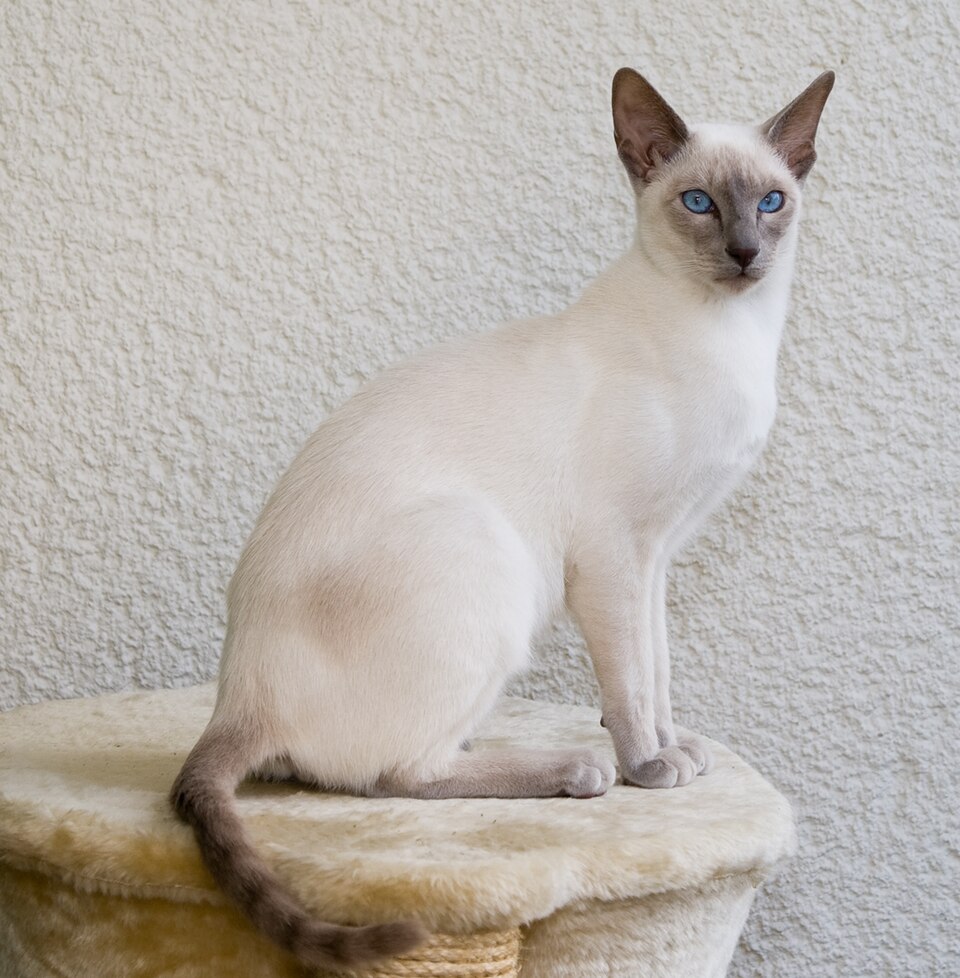
For an indoor cat, height and enrichment matter more than floor area.
The facts in one table
| Breed | Coat | Shedding | Weight | Life expectancy |
|---|---|---|---|---|
| Ragdoll | long | moderate | ≥ 9 kg | — |
| British Shorthair | short | high | — | — |
| Persian | long | high | — | — |
| Burmese | short | low | ≥ 5.4 kg | 14.4 years |
| Birman | long | moderate | — | 14.4 years |
| Russian Blue | short | moderate | 2.3–4.5 kg | — |
| Devon Rex | curly | low | 2.7–4.1 kg | — |
Coat and weight from the CFA breed pages. Which breeds appear is our editorial selection, explained on the page, and not a ranking published by any registry.
Sources: Cat Fanciers' Association · Royal Veterinary College — VetCompass
The room matters more than the breed
What an indoor cat is short of is not floor area but opportunity: height to climb, hiding places, a window with something happening outside, and a reason to stalk and pounce several times a day. A flat can supply all of that with shelves, a tall scratching post and ten minutes of play. A large house with bare walls and no play supplies none of it, and that is the flat-versus-house comparison that actually predicts a bored, frustrated cat.
That is why registry breed descriptions are a weak guide here. They describe personality in broad terms — active, affectionate, people-oriented — and the gap between two individuals of the same breed is wide enough to swamp it. The breed decides what the cat looks like and how much you brush it; the home decides how it lives.
Source: Cat Fanciers' Association
Coat, litter and smell in a small space
Two practical things scale badly in a small flat. The first is coat: a long-coated breed in a studio means hair on everything, and for the Maine Coon the CFA explicitly notes that breeders recommend combing to control shedding, prevent hairballs and protect against matting. Short-coated and curly-coated breeds reduce that load, though the Sphynx replaces it with regular bathing because of its oily skin.
The second is the litter tray, which has no good location in a small flat and still needs one away from food and in a quiet spot. The common advice to have one tray per cat plus one spare gets expensive in square metres, and it is the main reason two cats in a studio is a harder proposition than one.
Source: Cat Fanciers' Association
How long the arrangement lasts
An indoor cat is a long commitment, and the measured figure is worth knowing before signing up for a flat and a cat together: the VetCompass UK study puts life expectancy at birth at 11.74 years overall, with females at 12.51 years and males at 11.18. Burmese and Birman reach 14.4 years. That is a decade or more of litter trays, vertical space and vet appointments in the same home.
Breed-level figures describe populations, not the animal in front of you. For anything about a specific cat's health or care, consult a veterinarian.
Sources: Royal Veterinary College — VetCompass · Royal Veterinary College
What most people get wrong
- "Cats need outdoor access to be happy." What they need is height, hiding places, scratching and play. A flat can provide all four.
- "A bigger flat means a happier cat." Vertical space and enrichment matter more than floor area.
- "Some breeds are made for flats." No registry publishes such a list; breed descriptions cover coat, build and broad personality.
- "Two cats are twice as easy in a small space." Litter trays, feeding stations and escape routes all have to be duplicated, which is hardest in a small flat.
Source: Cat Fanciers' Association
Frequently asked questions
- Can any cat live in a flat?
- Most can, provided the flat gives vertical space, hiding places, something to scratch and daily play. Those matter more than the breed.
- Which cat breeds shed least in a small flat?
- The curly and near-hairless breeds — Cornish Rex, Devon Rex and Sphynx — have the least coat to shed, though the Sphynx needs regular bathing instead.
- How long will an indoor cat live?
- The VetCompass UK study gives 11.74 years of life expectancy at birth for cats overall, 12.51 years for females and 11.18 for males.
How to read the numbers
The numbers on “Cat breeds for apartments” come from the facts table at the top, with the official source alongside.
Where the data comes from
Each section of “Cat breeds for apartments” names its source (agency, university or breed club) with a verification date.
What this page doesn’t replace
Educational information, not a substitute for a vet, agronomist or specialist assessing your specific case.
Go deeper at the official source
To go deeper than “Cat breeds for apartments”, the source named below publishes the original document.
Words on this page
Hypoallergenic
A term used for breeds that shed less allergen into the environment, usually because they shed less fur. No dog or cat breed is fully allergen-free: a cat’s main allergen comes from saliva and skin, not only fur, and a very sensitive person can react to any breed.
Standard definition by American Kennel Club · Hypoallergenic
Life cycle
The sequence of stages an organism passes through from birth to death — for an animal, young, adult and senior; for a plant, germination, growth, flowering and, in annuals, death after setting seed.
Toxicity
A plant’s or substance’s capacity to harm an organism, which varies with the species exposed, the amount ingested and the animal’s size. A plant "toxic to dogs" is not necessarily toxic to humans at the same dose, and the reverse holds too.
Standard definition by ASPCA — Animal Poison Control Center · Toxicity
Hemisphere
Half of the globe split by the equator. The seasons flip between the two: when it is winter in the northern hemisphere, it is summer in the southern one, which shifts the pruning, bloom and harvest calendar described on this page.
Hardiness zone
A numbered band that ranks a region by the average coldest winter temperature it reaches, used to tell whether a plant survives there outdoors. The reference system is the US one (USDA), from zone 1, coldest, to 13, warmest.
Standard definition by USDA — Agricultural Research Service, Plant Hardiness Zone Map · Hardiness zone
Formative pruning vs. maintenance pruning
Formative pruning happens in a plant’s first years and sets the permanent shape of the main branches; maintenance pruning is yearly, removes dead, diseased or crossing branches, and does not change the plant’s architecture. Mixing the two up is the most common reason a fruit tree fails to bear fruit.
Sources
- Breeds — Cat Fanciers' Association. Checked on 2026-10-07.
- Life tables of annual life expectancy and risk factors for mortality in cats in the UK (JFMS, 2024) — Royal Veterinary College — VetCompass. Checked on 2026-10-07. 7.936 gatos que morreram entre 1/1/2019 e 31/3/2021, sob atendimento veterinário primário no Reino Unido.
- New research from the RVC predicts the future life expectancy for companion cats — Royal Veterinary College. Checked on 2026-10-07.