How long do tortoises live?
The range runs from decades to beyond a human lifetime, and it is set by species. The Smithsonian's National Zoo gives radiated tortoises 40 to 50 years and says Aldabra giant tortoises can reach ages of up to 150 years, with the animals on exhibit at the zoo around 80 years old. The U.S. Fish and Wildlife Service gives desert tortoises roughly 50 to 80 years, and the San Diego Zoo gives African spurred tortoises 80 to 100.
Updated on 2026-10-07.
These are population figures, not a prediction for one animal, and nothing here is a care plan. For anything about a specific animal's health, weight or age, consult a veterinarian.
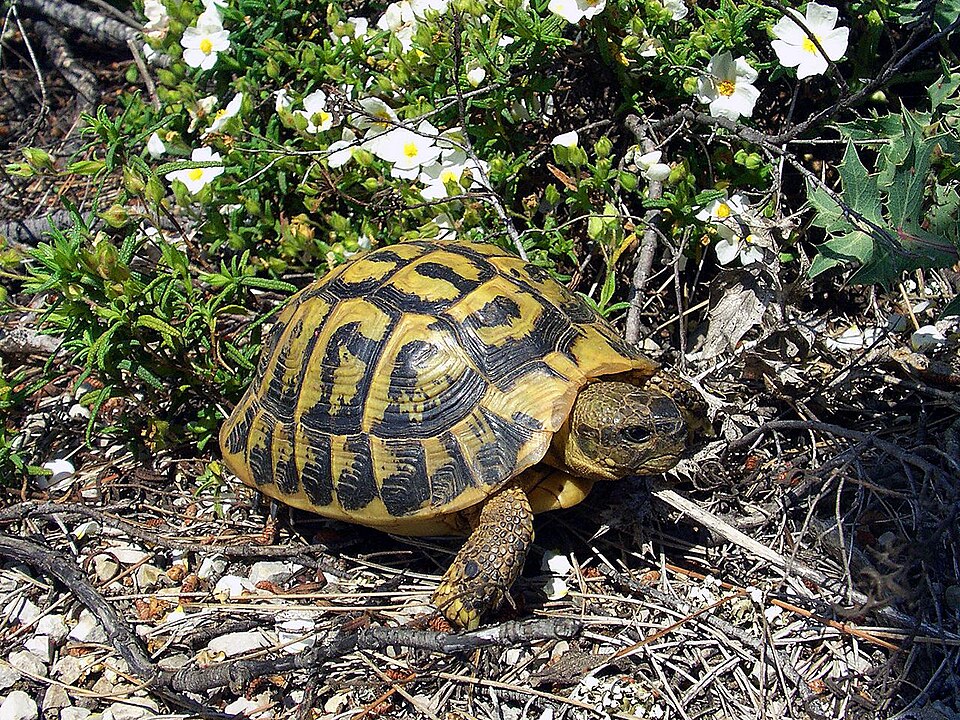
Land tortoises: even the smaller species are multi-decade animals.
The facts in one table
| Radiated tortoise | 40 to 50 years |
| Desert tortoise | Roughly 50 to 80 years |
| African spurred tortoise | 80 to 100 years |
| Aldabra giant tortoise | Up to 150 years |
| Aldabra tortoises on exhibit at the Smithsonian | About 80 years old |
| Land tortoises in general | Can live up to 150 years or more |
Figures from the Smithsonian's National Zoo, the San Diego Zoo Wildlife Alliance and the U.S. Fish and Wildlife Service, by species.
Sources: Smithsonian's National Zoo and Conservation Biology Institute · San Diego Zoo Wildlife Alliance · U.S. Fish and Wildlife Service
Four species, four different answers
The spread across the table is the point. A radiated tortoise at 40 to 50 years is a long-lived animal by any ordinary standard and still lives less than a third as long as an Aldabra giant. The giants are the species behind every "tortoises live 150 years" headline, and they are also the species almost nobody keeps: the pet trade is dominated by much smaller animals with much shorter — though still decades-long — lifespans.
The figures are also uneven in how they were produced. A desert tortoise range of 50 to 80 years comes from field biology on a wild population; the Aldabra figure comes from individuals followed in collections, and the Smithsonian is careful to note that its own animals are around 80 years old rather than claiming they will reach 150.
Sources: Smithsonian's National Zoo and Conservation Biology Institute · U.S. Fish and Wildlife Service · San Diego Zoo Wildlife Alliance
Why so long
Slow is the common thread. Tortoises grow slowly, mature late, have low metabolic rates and are protected by a shell that removes most predation risk once they are past the vulnerable juvenile stage. An animal that is hard to kill and cheap to run has little selective pressure towards a short life, and a great deal towards continuing to reproduce over many decades.
The same traits make them fragile as populations. A species that takes fifteen or twenty years to reach breeding age cannot recover quickly from losses, which is why several of the species in this table appear on conservation lists despite individuals living a century.
Sources: U.S. Fish and Wildlife Service · Smithsonian's National Zoo and Conservation Biology Institute
What a multi-decade animal means for an owner
Even the shorter-lived species in this table outlast most other pets by decades, and that is the most important practical fact about keeping one. A tortoise bought for a child is likely to outlive the child's interest, their time at home and sometimes their own lifetime — which is why rehoming and long-term provision come up constantly with these animals.
The husbandry side is equally species-specific: temperature, humidity, ultraviolet light, diet and hibernation requirements differ sharply between a Mediterranean species and an African one, and getting them wrong produces slow problems rather than obvious ones. That detail belongs with a reptile veterinarian who knows the species, not on a lifespan page.
These are population figures, not a prediction for one animal, and nothing here is a care plan. For anything about a specific animal's health, weight or age, consult a veterinarian.
Sources: U.S. Fish and Wildlife Service · San Diego Zoo Wildlife Alliance
What most people get wrong
- "Tortoises live 150 years." Only the giant species approach that. The published figures run from 40 to 50 years for a radiated tortoise upwards.
- "Tortoise and turtle are the same thing." Land tortoises and aquatic turtles differ in diet, housing and lifespan; the figures here are for land tortoises.
- "A long-lived species is a robust species." Several of these species are of conservation concern precisely because they breed slowly.
- "A small tortoise is a short-lived tortoise." Even the smaller species in this table are multi-decade commitments.
Sources: Smithsonian's National Zoo and Conservation Biology Institute · U.S. Fish and Wildlife Service
Frequently asked questions
- How long do tortoises live?
- It depends on the species: 40 to 50 years for a radiated tortoise, roughly 50 to 80 for a desert tortoise, 80 to 100 for an African spurred tortoise and up to 150 for an Aldabra giant.
- Which tortoise lives longest?
- The giant species. The Smithsonian states that Aldabra tortoises can reach ages of up to 150 years.
- How old are the Smithsonian's Aldabra tortoises?
- The zoo says the Aldabra tortoises on exhibit are about 80 years old.
How to read the numbers
The numbers on “How long do tortoises live?” come from the facts table at the top, with the official source alongside.
Where the data comes from
Each section of “How long do tortoises live?” names its source (agency, university or breed club) with a verification date.
What this page doesn’t replace
Educational information, not a substitute for a vet, agronomist or specialist assessing your specific case.
Go deeper at the official source
To go deeper than “How long do tortoises live?”, the source named below publishes the original document.
Smithsonian's National Zoo and Conservation Biology Institute
Words on this page
Life cycle
The sequence of stages an organism passes through from birth to death — for an animal, young, adult and senior; for a plant, germination, growth, flowering and, in annuals, death after setting seed.
Hypoallergenic
A term used for breeds that shed less allergen into the environment, usually because they shed less fur. No dog or cat breed is fully allergen-free: a cat’s main allergen comes from saliva and skin, not only fur, and a very sensitive person can react to any breed.
Standard definition by American Kennel Club · Hypoallergenic
Toxicity
A plant’s or substance’s capacity to harm an organism, which varies with the species exposed, the amount ingested and the animal’s size. A plant "toxic to dogs" is not necessarily toxic to humans at the same dose, and the reverse holds too.
Standard definition by ASPCA — Animal Poison Control Center · Toxicity
Dormancy
The period when a plant slows its metabolism and stops visible growth, usually in autumn and winter, to survive cold or drought. Pruning, transplanting or fertilising during dormancy is usually less stressful for the plant than doing it in full growth.
Hardiness zone
A numbered band that ranks a region by the average coldest winter temperature it reaches, used to tell whether a plant survives there outdoors. The reference system is the US one (USDA), from zone 1, coldest, to 13, warmest.
Standard definition by USDA — Agricultural Research Service, Plant Hardiness Zone Map · Hardiness zone
Formative pruning vs. maintenance pruning
Formative pruning happens in a plant’s first years and sets the permanent shape of the main branches; maintenance pruning is yearly, removes dead, diseased or crossing branches, and does not change the plant’s architecture. Mixing the two up is the most common reason a fruit tree fails to bear fruit.
Sources
- Aldabra tortoise — Smithsonian's National Zoo and Conservation Biology Institute. Checked on 2026-10-07.
- African Spurred Tortoise — San Diego Zoo Wildlife Alliance. Checked on 2026-10-07.
- Desert Tortoise (Gopherus agassizii) — life history — U.S. Fish and Wildlife Service. Checked on 2026-10-07.