What do turtles eat?
There is no single answer, because "turtle" covers animals with completely different diets. The green sea turtle is the odd one out among sea turtles: NOAA Fisheries describes adults as primarily herbivores that eat mostly seagrasses and algae. Leatherbacks live on jellyfish, hawksbills eat sponges off coral reefs, and the young of most species start out eating far more animal matter than their parents do.
Updated on 2026-10-07.
This page describes what the animal eats in the wild and, where relevant, in human care. It is general information, not a consultation: if an animal is unwell or has eaten something it should not have, consult a veterinarian.
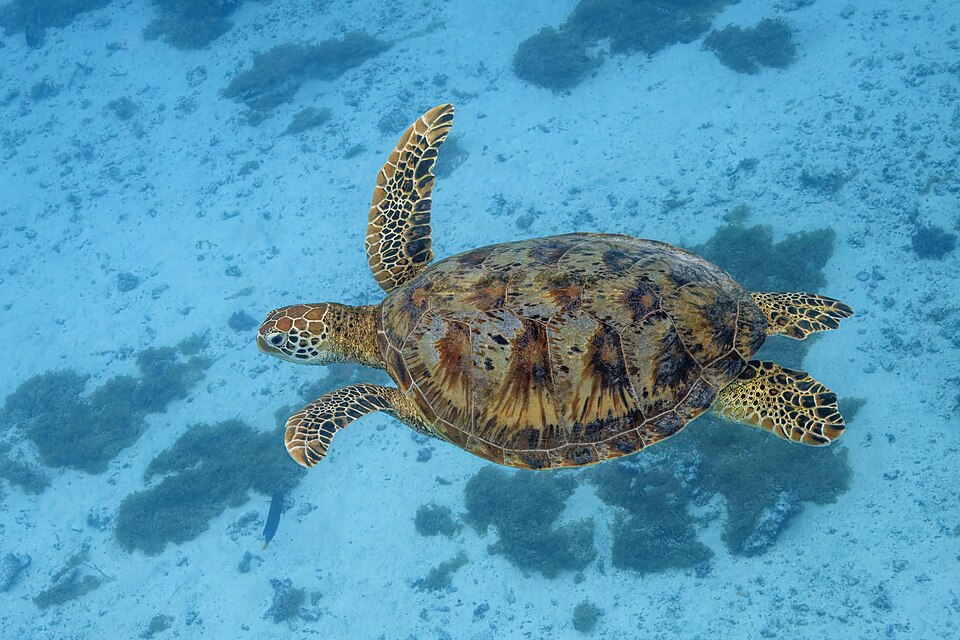
Green sea turtle (Chelonia mydas), the one mainly plant-eating sea turtle.
The facts in one table
| Feeding type | herbivore / omnivore (adult / juvenile) |
| Adult green turtle | Mostly seagrasses and algae; also sponges and other invertebrates |
| Young green turtle at sea | Plant and animal life from drifting communities such as pelagic Sargassum |
| Leatherback turtle | Jellyfish and other soft-bodied open-ocean animals |
| Hawksbill turtle | Sponges on coral reefs |
| Length | 0.9–1.2 m (adult) |
| Weight | 113–181 kg (adult) |
| Lifespan | ≥ 70 years (estimated) |
Source for each row: NOAA Fisheries species pages for the green, leatherback and hawksbill turtle.
Sources: NOAA Fisheries · NOAA Fisheries · NOAA Fisheries
The diet depends on which turtle you mean
Sea turtles are the clearest illustration of how far apart turtle diets can be. Green turtles crop seagrass meadows and algae and keep those meadows productive in the process, which is why they are treated as a grazing species rather than a predator. Leatherbacks are built for a diet of jellyfish and other gelatinous animals, which is also why floating plastic bags are so dangerous to them. Hawksbills take sponges from reef faces, a food almost nothing else can digest.
Freshwater and land turtles widen the picture further. Many pond turtles are opportunistic omnivores that take insects, snails, fish and aquatic plants, while tortoises are land grazers that live on leaves, grasses and flowers. If you are asking about an animal in a tank at home rather than one in the sea, the answer is set by the species you have, not by the word "turtle".
Sources: NOAA Fisheries · NOAA Fisheries · NOAA Fisheries · RSPCA
Young turtles eat differently from adults
NOAA describes young green turtles in the open ocean feeding on the plant and animal life found in drifting communities such as pelagic Sargassum, rather than grazing seagrass the way adults do. The switch to a plant-dominated diet happens when the animal moves into coastal foraging grounds. Population matters too: NOAA notes that the East Pacific population tends to eat more animal prey than other green turtle populations, so even within one species the diet is not fixed.
Source: NOAA Fisheries
Turtles kept at home
For aquatic pet turtles the RSPCA describes a varied diet built on a quality dried food for the species, with thoroughly defrosted freshwater fish, live invertebrate foods such as river shrimp and bloodworm, live plants like pondweed, and cuttlefish bone as a source of calcium. It also warns that these animals are opportunistic feeders that will overeat if allowed to, which is why it recommends feeding every two days and only as much as the animal clears in about five minutes, removing what is left.
Two problems come up often enough to be worth naming. The first is feeding one single food, which the RSPCA warns against because of the build-up of toxins; the second is vitamin A deficiency, which is linked to eye problems and is the reason beta-carotene-rich vegetables are recommended. Species and age change the right answer, so the diet for the animal in front of you is a question for a veterinarian who sees reptiles.
This page describes what the animal eats in the wild and, where relevant, in human care. It is general information, not a consultation: if an animal is unwell or has eaten something it should not have, consult a veterinarian.
Source: RSPCA
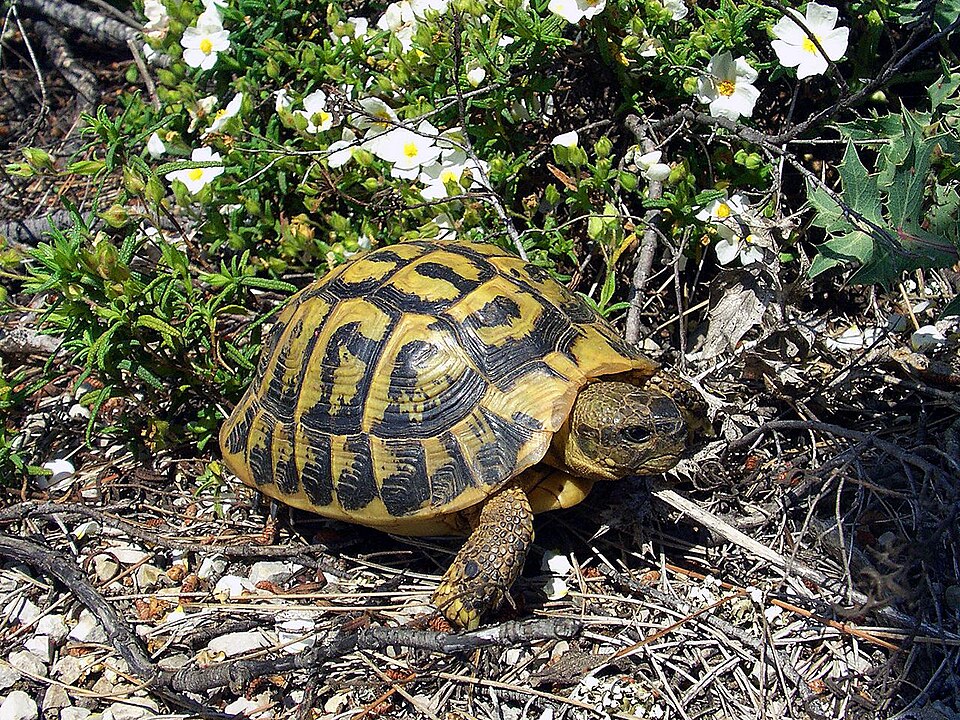
Hermann's tortoise (Testudo hermanni): a land grazer, with a diet unlike any sea turtle's.
What most people get wrong
- "Turtles are herbivores." Only some are, and only at some ages. Among sea turtles the green turtle is the mainly plant-eating exception, not the rule.
- "Lettuce is a complete diet." It is not: a single food is exactly what the RSPCA warns against for pet turtles, and calcium and vitamin A are the usual casualties.
- "Sea turtles eat jellyfish." Leatherbacks do. Hawksbills eat sponges and green turtles graze seagrass — mixing them up is how wrong feeding advice spreads.
Sources: NOAA Fisheries · NOAA Fisheries · NOAA Fisheries · RSPCA
Frequently asked questions
- What do green sea turtles eat?
- NOAA Fisheries describes adults as primarily herbivores eating mostly seagrasses and algae, with sponges and other invertebrates taken as well.
- How long do sea turtles live and how big do they get?
- For the green turtle NOAA gives an adult length of 3 to 4 feet (about 0.9–1.2 m) and a weight of 250 to 400 pounds (about 113–181 kg), with a lifespan that is unknown but estimated at 70 years or more.
- Can I feed a wild turtle I found?
- No. Feeding wild animals changes their behaviour and can harm them, and a turtle out of place may be sick or injured. Contact a licensed wildlife rehabilitator or a veterinarian instead.
- Do baby turtles eat the same food as adults?
- Often not. NOAA describes young green turtles feeding in drifting open-ocean communities such as Sargassum, and only moving to a seagrass-dominated diet once they reach coastal foraging grounds.
How to read the numbers
The numbers on “What do turtles eat?” come from the facts table at the top, with the official source alongside.
Where the data comes from
Each section of “What do turtles eat?” names its source (agency, university or breed club) with a verification date.
What this page doesn’t replace
Educational information, not a substitute for a vet, agronomist or specialist assessing your specific case.
Go deeper at the official source
To go deeper than “What do turtles eat?”, the source named below publishes the original document.
Words on this page
Toxicity
A plant’s or substance’s capacity to harm an organism, which varies with the species exposed, the amount ingested and the animal’s size. A plant "toxic to dogs" is not necessarily toxic to humans at the same dose, and the reverse holds too.
Standard definition by ASPCA — Animal Poison Control Center · Toxicity
Life cycle
The sequence of stages an organism passes through from birth to death — for an animal, young, adult and senior; for a plant, germination, growth, flowering and, in annuals, death after setting seed.
Hypoallergenic
A term used for breeds that shed less allergen into the environment, usually because they shed less fur. No dog or cat breed is fully allergen-free: a cat’s main allergen comes from saliva and skin, not only fur, and a very sensitive person can react to any breed.
Standard definition by American Kennel Club · Hypoallergenic
Hemisphere
Half of the globe split by the equator. The seasons flip between the two: when it is winter in the northern hemisphere, it is summer in the southern one, which shifts the pruning, bloom and harvest calendar described on this page.
Dormancy
The period when a plant slows its metabolism and stops visible growth, usually in autumn and winter, to survive cold or drought. Pruning, transplanting or fertilising during dormancy is usually less stressful for the plant than doing it in full growth.
Hardiness zone
A numbered band that ranks a region by the average coldest winter temperature it reaches, used to tell whether a plant survives there outdoors. The reference system is the US one (USDA), from zone 1, coldest, to 13, warmest.
Standard definition by USDA — Agricultural Research Service, Plant Hardiness Zone Map · Hardiness zone
Sources
- Green Turtle — NOAA Fisheries. Checked on 2026-10-07.
- Leatherback Turtle — NOAA Fisheries. Checked on 2026-10-07.
- Hawksbill Turtle — NOAA Fisheries. Checked on 2026-10-07.
- How to care for a terrapin — RSPCA. Checked on 2026-10-07.