What do frogs eat?
The answer changes completely across one animal's life. The National Park Service describes frogs and toads as carnivorous, usually eating a varied diet of insects, spiders and worms — the adult Gray Tree Frog, for example, takes mites, spiders, plant lice, snails and slugs. Tadpoles are a different animal in practice: most are herbivorous and eat algae, plants and decaying organic matter, although some are carnivorous and will even eat other tadpoles.
Updated on 2026-10-07.
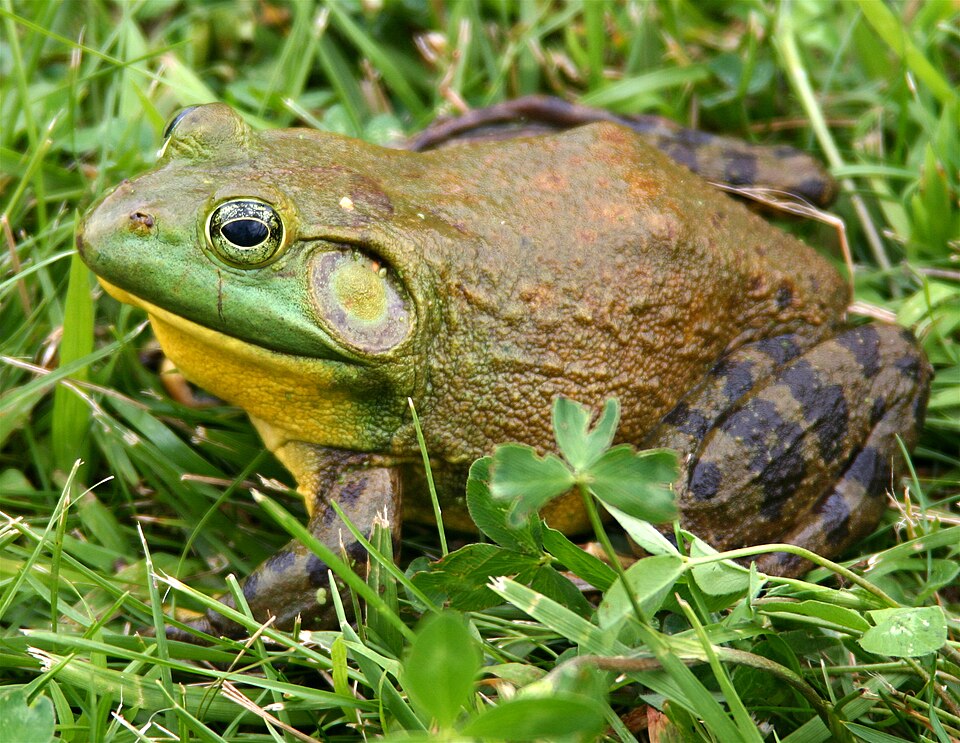
American bullfrog (Lithobates catesbeianus): herbivorous as a tadpole, a generalist predator as an adult.
The facts in one table
| Feeding type | carnivore / herbivore (adult / tadpole) |
| Adults | Carnivorous: insects, spiders and worms; larger species take bigger prey |
| Example adult diet | Gray tree frog: mites, spiders, plant lice, snails and slugs |
| Tadpoles | Mostly herbivorous: algae, plant material and decaying organic matter |
| Bullfrog tadpoles | Mainly herbivorous — algae and aquatic plant material, with some invertebrates |
Source for each row: U.S. National Park Service and U.S. Fish and Wildlife Service.
Sources: U.S. National Park Service · U.S. Fish and Wildlife Service
Metamorphosis rebuilds the animal around a new diet
Losing gills and a tail and growing lungs and legs is the famous part of metamorphosis, but the digestive system is rebuilt too. The change from larva to adult rearranges the skull and its muscles, the mouth apparatus and the gastrointestinal tract — which is what allows a plant-grazing tadpole to become an insect-catching adult. The diet shift is not a preference that develops; it is anatomy.
For a bullfrog, the USFWS screening summary describes tadpoles as mainly herbivorous, taking algae and aquatic plant material with some invertebrates. The adult of the same species is a generalist predator big enough to take prey that would be impossible for most frogs. Same animal, two diets, a few months apart.
Sources: U.S. National Park Service · U.S. Fish and Wildlife Service
What an adult frog can actually catch
Adult frogs are ambush hunters that respond to movement, which sets the menu as much as taste does: slow, soft, moving, and small enough to swallow. That covers insects, spiders, worms, snails and slugs for a small tree frog, and extends to anything a very large frog can fit in its mouth. A frog will generally ignore food that does not move, which is why keepers of captive amphibians feed live or moving prey.
Source: U.S. National Park Service
Frogs in a garden are eating your pests
A garden frog is a slug-and-insect eater working for free, which makes it worth keeping around — and worth protecting from the two things that remove it fastest, slug pellets and a pond with no shallow exit. There is no need, and no benefit, in offering food: an adult frog hunts live prey and will not take anything from a dish.
The tadpole half of the life cycle needs something different from the pond itself: algae and decaying plant material, which means a pond that is a little bit untidy feeds them better than one that is scrubbed clean. Leaving some submerged plants and last autumn's leaf litter in a corner is, in practice, stocking the larder for the next generation.
Sources: U.S. National Park Service · U.S. Fish and Wildlife Service
What most people get wrong
- "Frogs eat only flies." The NPS list for adults is insects, spiders and worms, and a tree frog's diet includes mites, plant lice, snails and slugs.
- "Tadpoles eat the same food as frogs." Most tadpoles are herbivores living on algae and decaying plant matter; the diet changes with metamorphosis.
- "You can feed a wild frog bread or meat." An adult frog responds to live, moving prey. Putting food out does nothing useful and can foul a pond.
Sources: U.S. National Park Service · U.S. Fish and Wildlife Service
Frequently asked questions
- What do tadpoles eat?
- Most are herbivorous and eat algae, plants and decaying organic matter; some species are carnivorous and may eat other tadpoles.
- Are frogs carnivores?
- As adults, yes. The National Park Service describes frogs and toads as carnivorous, usually eating insects, spiders and worms.
- Do frogs eat slugs and snails?
- Some do. The NPS account of the adult Gray Tree Frog includes snails and slugs along with mites, spiders and plant lice.
How to read the numbers
The numbers on “What do frogs eat?” come from the facts table at the top, with the official source alongside.
Where the data comes from
Each section of “What do frogs eat?” names its source (agency, university or breed club) with a verification date.
What this page doesn’t replace
Educational information, not a substitute for a vet, agronomist or specialist assessing your specific case.
Words on this page
Toxicity
A plant’s or substance’s capacity to harm an organism, which varies with the species exposed, the amount ingested and the animal’s size. A plant "toxic to dogs" is not necessarily toxic to humans at the same dose, and the reverse holds too.
Standard definition by ASPCA — Animal Poison Control Center · Toxicity
Life cycle
The sequence of stages an organism passes through from birth to death — for an animal, young, adult and senior; for a plant, germination, growth, flowering and, in annuals, death after setting seed.
Hypoallergenic
A term used for breeds that shed less allergen into the environment, usually because they shed less fur. No dog or cat breed is fully allergen-free: a cat’s main allergen comes from saliva and skin, not only fur, and a very sensitive person can react to any breed.
Standard definition by American Kennel Club · Hypoallergenic
Hemisphere
Half of the globe split by the equator. The seasons flip between the two: when it is winter in the northern hemisphere, it is summer in the southern one, which shifts the pruning, bloom and harvest calendar described on this page.
Dormancy
The period when a plant slows its metabolism and stops visible growth, usually in autumn and winter, to survive cold or drought. Pruning, transplanting or fertilising during dormancy is usually less stressful for the plant than doing it in full growth.
Hardiness zone
A numbered band that ranks a region by the average coldest winter temperature it reaches, used to tell whether a plant survives there outdoors. The reference system is the US one (USDA), from zone 1, coldest, to 13, warmest.
Standard definition by USDA — Agricultural Research Service, Plant Hardiness Zone Map · Hardiness zone
Sources
- Frogs and Toads — U.S. National Park Service. Checked on 2026-10-07.
- Ecological Risk Screening Summary — American Bullfrog — U.S. Fish and Wildlife Service. Checked on 2026-10-07.
- The Hidden Harm in Feeding Your Local Wildlife — U.S. Fish and Wildlife Service. Checked on 2026-10-07.