What do owls eat?
Small mammals, overwhelmingly. The Cornell Lab of Ornithology describes the American Barn Owl eating mostly rats, mice, voles, lemmings and other rodents, along with shrews, bats and rabbits, and occasionally birds such as starlings, blackbirds and meadowlarks. One detail in that account explains a lot: because most of the prey is active at night, daytime animals like squirrels and chipmunks are relatively safe from these owls.
Updated on 2026-10-07.
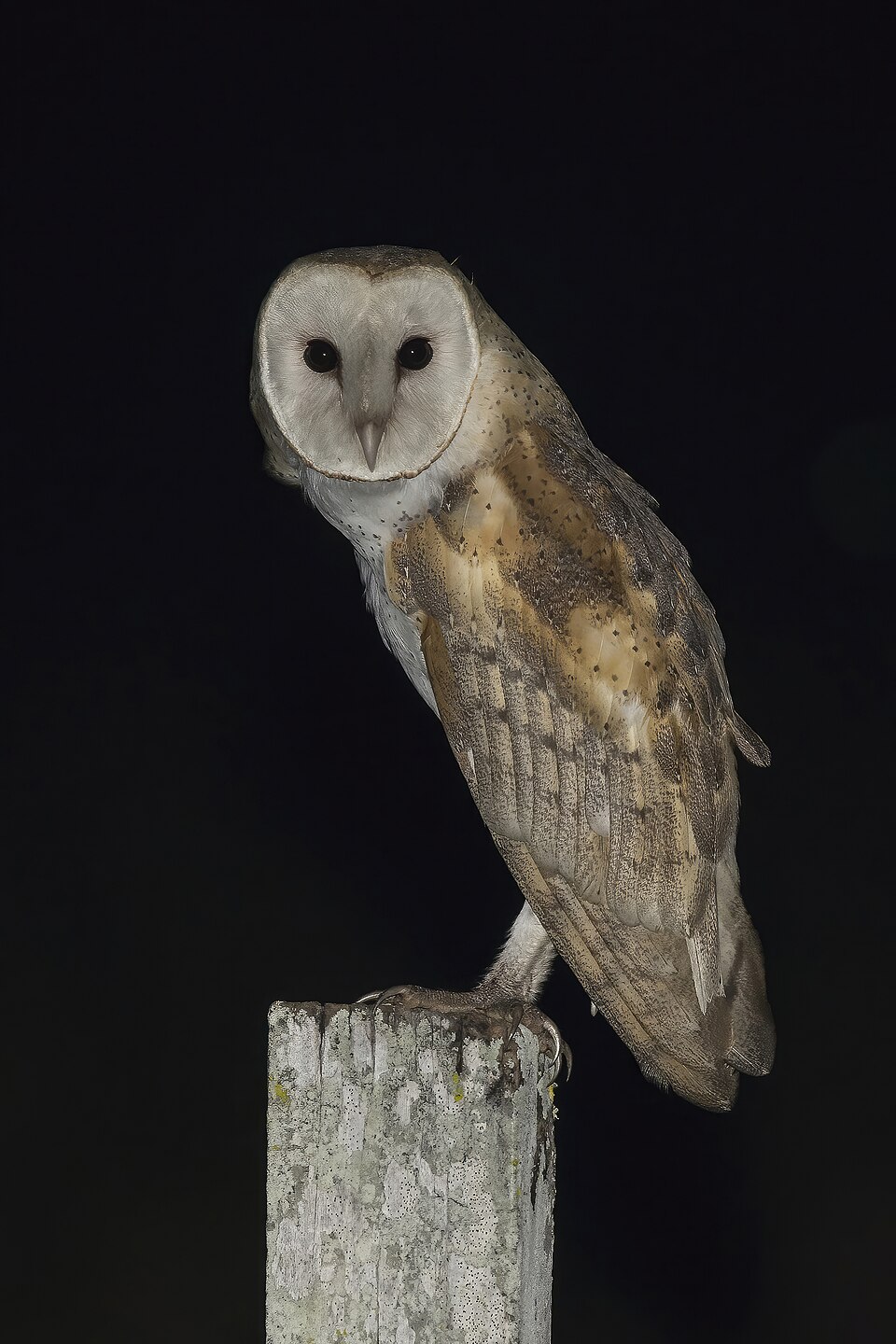
American barn owl (Tyto furcata): the dish-shaped face funnels sound well enough to hunt in the dark.
The facts in one table
| Feeding type | carnivore |
| Main prey | Small mammals: rats, mice, voles, lemmings and other rodents |
| Also taken | Shrews, bats and rabbits; occasionally birds such as starlings, blackbirds and meadowlarks |
| Rarely taken | Squirrels and chipmunks, which are active by day |
| How it hunts | Slow, low flight over open fields at night, locating prey by hearing |
| Evidence left behind | Pellets of bone and fur, regurgitated after digestion |
Source for each row: Cornell Lab of Ornithology, American Barn Owl life history.
The hunt is built around hearing, not sight
Cornell describes the barn owl flying slowly and low over open fields at night or dusk, with slow wingbeats and a looping, buoyant flight. What makes that work is the face: the satellite-dish shape funnels sound to the ears well enough to locate a mouse moving in grass in complete darkness. The owl is not scanning for prey so much as listening for it.
That hunting style also defines where owls are useful. A bird that works open grassland at night and lives on rodents is, in farming terms, free pest control — which is why barn owl nest boxes are a standard tool on farms rather than a decoration.
Pellets: the diet you can read
Owls swallow prey whole or in large pieces and later bring up a compact pellet of the parts they cannot digest — bone, fur and teeth. Because the skulls and jaws survive, a pellet is a readable record of what that bird ate, which is why pellet dissection is a staple of school biology and also how a lot of what we know about owl diets was measured in the first place.
Storing food at the nest
Cornell notes that nesting barn owls sometimes store dozens of prey items at the nest site while incubating, ready to feed the young once they hatch. It is a useful corrective to the image of an owl eating as it goes: during the breeding season the bird is provisioning a larder, and the number of rodents a pair removes from the surrounding fields over a season is correspondingly large.
Caching also makes the diet measurable. A nest with a stored row of voles tells a researcher what the pair is catching that week, in that field, without waiting for pellets to accumulate — which is part of why barn owl diets are among the best described of any bird of prey.
What most people get wrong
- "Owls eat anything that moves." The prey list is dominated by nocturnal small mammals; squirrels and chipmunks are comparatively safe because they are active by day.
- "Owls find prey with their huge eyes." Eyesight helps, but Cornell credits the hearing, aided by the dish-shaped face, with locating prey in complete darkness.
- "All owls eat the same things." Diets vary by species and size — some take insects and small birds, others take prey as large as rabbits.
Frequently asked questions
- What is an owl's main prey?
- For the American Barn Owl, Cornell lists mostly small mammals: rats, mice, voles, lemmings and other rodents, plus shrews, bats and rabbits.
- Do owls eat birds?
- Occasionally. Cornell mentions starlings, blackbirds and meadowlarks among the birds taken, but mammals dominate the diet.
- What is an owl pellet?
- The compact mass of bone and fur an owl regurgitates after digesting prey swallowed whole. Because the bones survive, pellets show exactly what the bird ate.
How to read the numbers
The numbers on “What do owls eat?” come from the facts table at the top, with the official source alongside.
Where the data comes from
Each section of “What do owls eat?” names its source (agency, university or breed club) with a verification date.
What this page doesn’t replace
Educational information, not a substitute for a vet, agronomist or specialist assessing your specific case.
Words on this page
Toxicity
A plant’s or substance’s capacity to harm an organism, which varies with the species exposed, the amount ingested and the animal’s size. A plant "toxic to dogs" is not necessarily toxic to humans at the same dose, and the reverse holds too.
Standard definition by ASPCA — Animal Poison Control Center · Toxicity
Life cycle
The sequence of stages an organism passes through from birth to death — for an animal, young, adult and senior; for a plant, germination, growth, flowering and, in annuals, death after setting seed.
Hypoallergenic
A term used for breeds that shed less allergen into the environment, usually because they shed less fur. No dog or cat breed is fully allergen-free: a cat’s main allergen comes from saliva and skin, not only fur, and a very sensitive person can react to any breed.
Standard definition by American Kennel Club · Hypoallergenic
Hemisphere
Half of the globe split by the equator. The seasons flip between the two: when it is winter in the northern hemisphere, it is summer in the southern one, which shifts the pruning, bloom and harvest calendar described on this page.
Dormancy
The period when a plant slows its metabolism and stops visible growth, usually in autumn and winter, to survive cold or drought. Pruning, transplanting or fertilising during dormancy is usually less stressful for the plant than doing it in full growth.
Formative pruning vs. maintenance pruning
Formative pruning happens in a plant’s first years and sets the permanent shape of the main branches; maintenance pruning is yearly, removes dead, diseased or crossing branches, and does not change the plant’s architecture. Mixing the two up is the most common reason a fruit tree fails to bear fruit.
Sources
- American Barn Owl — Life History — Cornell Lab of Ornithology (All About Birds). Checked on 2026-10-07.