What do hummingbirds eat?
Two things, for two different jobs. The sugar comes from nectar: the Cornell Lab of Ornithology lists the Ruby-throated Hummingbird feeding at red or orange tubular flowers such as trumpet creeper, cardinal flower, honeysuckle, jewelweed, bee-balm, red buckeye and red morning glory, plus feeders and sometimes tree sap. The protein comes from animals — mosquitoes, gnats, fruit flies and small bees caught in midair or pulled out of spider webs, and spiders themselves.
Updated on 2026-10-07.
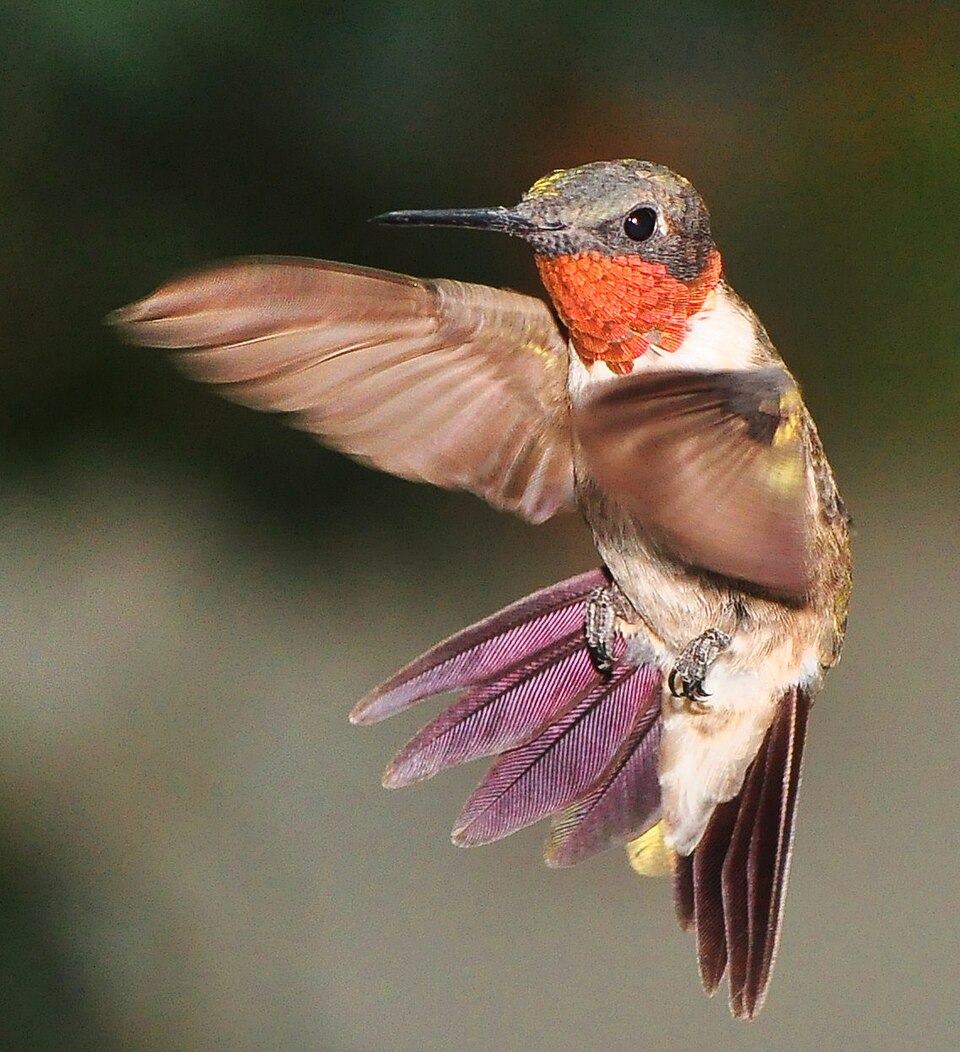
Ruby-throated hummingbird (Archilochus colubris) hovering — the flight style that makes the diet necessary.
The facts in one table
| Feeding type | nectarivore, with insects for protein |
| Nectar sources | Red or orange tubular flowers: trumpet creeper, cardinal flower, honeysuckle, jewelweed, bee-balm, red buckeye, red morning glory |
| Other sugar | Hummingbird feeders and, sometimes, tree sap |
| Animal prey | Mosquitoes, gnats, fruit flies and small bees, caught in midair or taken from spider webs; also spiders |
Source for each row: Cornell Lab of Ornithology, Ruby-throated Hummingbird life history.
Nectar is the fuel; insects are the building material
Sugar water, whether from a flower or a feeder, is almost pure energy — and a bird that hovers needs a great deal of energy. But nothing in nectar builds muscle, feathers or eggs, which is why the insect half of the diet is not an occasional extra. Mosquitoes, gnats, fruit flies and small bees supply the protein, and spiders are taken as well, sometimes along with whatever is already caught in the web.
This is the single most useful thing to know if you keep a feeder: the feeder covers one half of the diet and cannot cover the other. A garden that also holds insects and spiders is doing more for hummingbirds than a garden with a feeder and nothing else.
Why the flying style and the diet go together
Cornell describes ruby-throats as precision flyers able to fly flat out and stop instantly, hang motionless in midair and adjust up, down, sideways and backwards with minute control. That is the flight profile of an animal that feeds at flowers it cannot land on and catches small insects on the wing. The cost is a metabolism that has to be refuelled constantly, which closes the loop back to nectar.
Planting for hummingbirds instead of feeding them
The flower list in the Cornell account is a planting list. Tubular red and orange flowers are shaped for a long bill and a hovering visitor, and a sequence of them through the season gives a far steadier food supply than a feeder that may be forgotten or left to ferment in the heat. It also brings the insects that make up the other half of the diet, which no sugar solution does.
Scale is reassuring here: Partners in Flight estimates a global breeding population of 36 million Ruby-throated Hummingbirds and rates the species of low conservation concern. The point of planting for them is not rescue, then, but keeping a common bird common — and the same flowers feed bees and moths at the same time.
What most people get wrong
- "Hummingbirds only drink nectar." Cornell lists mosquitoes, gnats, fruit flies, small bees and spiders as main animal prey — the protein has to come from somewhere.
- "A feeder is all they need." A feeder supplies sugar only. Insects and spiders are the other half of the diet.
- "Red dye attracts them." What the Cornell account describes is red and orange tubular flowers — the colour of the flower, not an additive in the water.
Frequently asked questions
- Do hummingbirds eat insects?
- Yes. Cornell lists mosquitoes, gnats, fruit flies and small bees as main insect prey, caught in midair or taken from spider webs, plus spiders themselves.
- Which flowers do hummingbirds feed at?
- Cornell names red or orange tubular flowers including trumpet creeper, cardinal flower, honeysuckle, jewelweed, bee-balm, red buckeye and red morning glory.
- Do hummingbirds drink tree sap?
- Sometimes. Cornell lists tree sap alongside flower nectar and feeders as a sugar source.
How to read the numbers
The numbers on “What do hummingbirds eat?” come from the facts table at the top, with the official source alongside.
Where the data comes from
Each section of “What do hummingbirds eat?” names its source (agency, university or breed club) with a verification date.
What this page doesn’t replace
Educational information, not a substitute for a vet, agronomist or specialist assessing your specific case.
Words on this page
Toxicity
A plant’s or substance’s capacity to harm an organism, which varies with the species exposed, the amount ingested and the animal’s size. A plant "toxic to dogs" is not necessarily toxic to humans at the same dose, and the reverse holds too.
Standard definition by ASPCA — Animal Poison Control Center · Toxicity
Life cycle
The sequence of stages an organism passes through from birth to death — for an animal, young, adult and senior; for a plant, germination, growth, flowering and, in annuals, death after setting seed.
Hypoallergenic
A term used for breeds that shed less allergen into the environment, usually because they shed less fur. No dog or cat breed is fully allergen-free: a cat’s main allergen comes from saliva and skin, not only fur, and a very sensitive person can react to any breed.
Standard definition by American Kennel Club · Hypoallergenic
Hemisphere
Half of the globe split by the equator. The seasons flip between the two: when it is winter in the northern hemisphere, it is summer in the southern one, which shifts the pruning, bloom and harvest calendar described on this page.
Dormancy
The period when a plant slows its metabolism and stops visible growth, usually in autumn and winter, to survive cold or drought. Pruning, transplanting or fertilising during dormancy is usually less stressful for the plant than doing it in full growth.
Formative pruning vs. maintenance pruning
Formative pruning happens in a plant’s first years and sets the permanent shape of the main branches; maintenance pruning is yearly, removes dead, diseased or crossing branches, and does not change the plant’s architecture. Mixing the two up is the most common reason a fruit tree fails to bear fruit.
Sources
- Ruby-throated Hummingbird — Life History — Cornell Lab of Ornithology (All About Birds). Checked on 2026-10-07.