What do bees eat?
Two foods, with two separate roles. The USDA Agricultural Research Service describes the honey bee's natural diet as coming primarily from nectar and pollen gathered from a wide variety of flowers: flower nectar supplies the sugars, while pollen supplies protein as well as vitamins, minerals and fats. The carbohydrate powers the adults; the pollen is what the next generation of larvae is built from.
Updated on 2026-10-07.
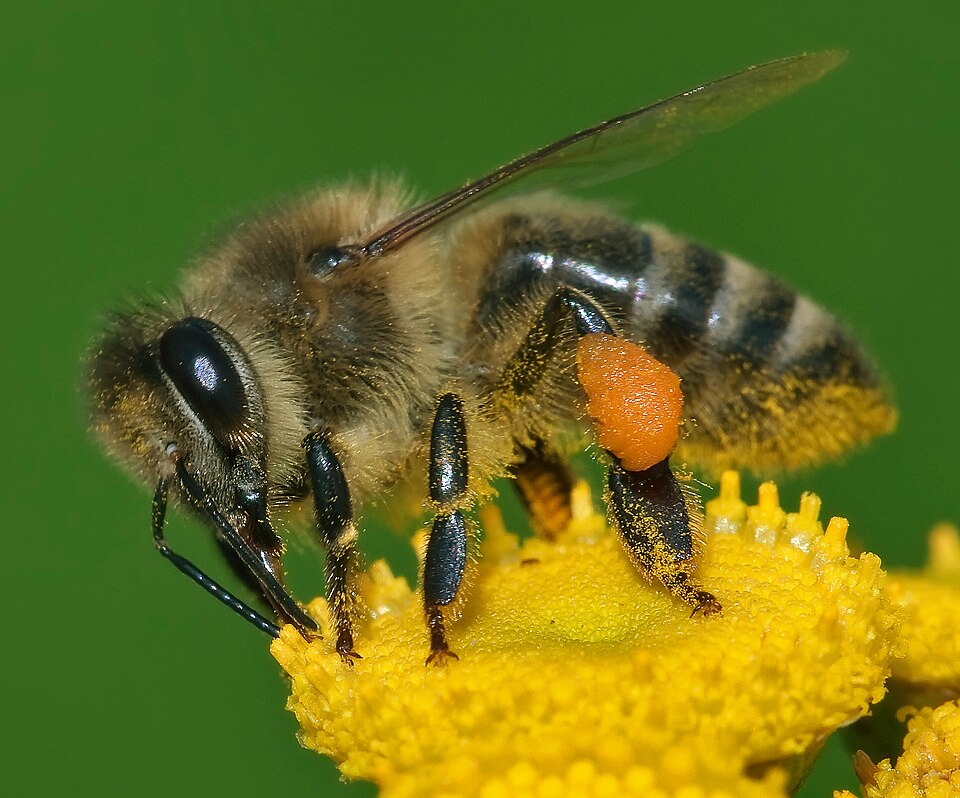
Western honey bee (Apis mellifera): nectar for sugar, pollen for protein.
The facts in one table
| Feeding type | nectarivore and pollen feeder |
| Carbohydrate | Flower nectar; also aphid honeydew and other sugar sources such as tree sap |
| Protein, vitamins, minerals and fats | Pollen |
| Stored pollen | Nectar and honey are added to collected pollen to make "beebread" |
| Larvae | Royal jelly in the first days; future queens are fed royal jelly throughout development |
| Why variety matters | A single pollen source, such as sunflower, does not supply enough protein |
Source for each row: USDA Agricultural Research Service and Penn State Extension.
Sources: USDA Agricultural Research Service · USDA Agricultural Research Service · Penn State Extension
Nectar is fuel; pollen is material
The division is clean enough to be worth stating twice. Nectar is a sugar solution: it is energy for flight, for warming the colony and for the work of foraging. Pollen is the protein, fat, vitamin and mineral source, and the ARS is explicit that both adults and larvae depend on it to grow their bodies into adulthood. A colony with abundant nectar and no pollen is a colony that cannot raise brood.
Bees also take sugar from places that are not flowers. The ARS mentions aphid honeydew and other sugar sources such as tree sap alongside floral nectar — useful when flowers are scarce, and a reminder that honey production is about available sugar, wherever it comes from.
Sources: USDA Agricultural Research Service · USDA Agricultural Research Service
Beebread: pollen that has been processed
Pollen is not stored raw. Bees collect it, pack it into cells and add nectar and honey, producing what the research literature calls stored pollen or beebread. The ARS notes an interesting detail: bees prefer to consume freshly stored pollen cells over older ones. So the colony is not just hoarding protein, it is managing the age and quality of its protein store.
Sources: USDA Agricultural Research Service · USDA Agricultural Research Service
What larvae eat — and how a queen is made
Larval feeding is where the diet becomes decisive. Royal jelly, a secretion produced by young worker bees, is fed to larvae in the first days of development. Penn State Extension describes worker-destined larvae moving onto a mixture of royal jelly, pollen and nectar, while larvae destined to be queens continue on royal jelly throughout development. The nurse bees that produce that jelly have to eat large quantities of pollen and nectar to do it, which closes the loop back to foraging.
Sources: Penn State Extension · USDA Agricultural Research Service
Why a monoculture is a poor diet
One of the clearest findings in the ARS material is that variety is not a luxury: sunflower pollen alone will not supply bees with enough protein. Different pollens have different amino acid profiles, so a landscape with one mass-flowering crop and nothing else is nutritionally thin even when it looks abundant. For anyone planting with bees in mind, the useful goal is a mix of species flowering in sequence rather than a large patch of one thing.
Sources: USDA Agricultural Research Service · USDA Agricultural Research Service
What most people get wrong
- "Bees eat honey." Honey is stored nectar — a carbohydrate reserve. The protein in a bee's diet comes from pollen, and larvae depend on it.
- "One big patch of flowers is enough." The ARS is clear that a single pollen source, such as sunflower, does not supply enough protein; a mix of species does.
- "Pollen is just something stuck to their legs." It is the colony's protein supply, processed with nectar and honey into stored pollen, or beebread.
Sources: USDA Agricultural Research Service · USDA Agricultural Research Service
Frequently asked questions
- Do bees eat pollen or just collect it?
- They eat it. Pollen supplies protein, vitamins, minerals and fats, and both adults and larvae depend on it, according to the USDA Agricultural Research Service.
- What is royal jelly?
- A secretion produced by young worker bees, fed to larvae in their first days. Larvae destined to become queens are fed royal jelly throughout development.
- Do bees only feed on flowers?
- Mostly, but the ARS also lists aphid honeydew and other sugar sources such as tree sap as carbohydrate sources.
How to read the numbers
The numbers on “What do bees eat?” come from the facts table at the top, with the official source alongside.
Where the data comes from
Each section of “What do bees eat?” names its source (agency, university or breed club) with a verification date.
What this page doesn’t replace
Educational information, not a substitute for a vet, agronomist or specialist assessing your specific case.
Words on this page
Toxicity
A plant’s or substance’s capacity to harm an organism, which varies with the species exposed, the amount ingested and the animal’s size. A plant "toxic to dogs" is not necessarily toxic to humans at the same dose, and the reverse holds too.
Standard definition by ASPCA — Animal Poison Control Center · Toxicity
Life cycle
The sequence of stages an organism passes through from birth to death — for an animal, young, adult and senior; for a plant, germination, growth, flowering and, in annuals, death after setting seed.
Hypoallergenic
A term used for breeds that shed less allergen into the environment, usually because they shed less fur. No dog or cat breed is fully allergen-free: a cat’s main allergen comes from saliva and skin, not only fur, and a very sensitive person can react to any breed.
Standard definition by American Kennel Club · Hypoallergenic
Hemisphere
Half of the globe split by the equator. The seasons flip between the two: when it is winter in the northern hemisphere, it is summer in the southern one, which shifts the pruning, bloom and harvest calendar described on this page.
Dormancy
The period when a plant slows its metabolism and stops visible growth, usually in autumn and winter, to survive cold or drought. Pruning, transplanting or fertilising during dormancy is usually less stressful for the plant than doing it in full growth.
Formative pruning vs. maintenance pruning
Formative pruning happens in a plant’s first years and sets the permanent shape of the main branches; maintenance pruning is yearly, removes dead, diseased or crossing branches, and does not change the plant’s architecture. Mixing the two up is the most common reason a fruit tree fails to bear fruit.
Sources
- The Buzz About Bees / Honey bee nutrition research — USDA Agricultural Research Service. Checked on 2026-10-07.
- ARS Honey Bee Health — USDA Agricultural Research Service. Checked on 2026-10-07.
- An Introduction to Queen Honey Bee Development — Penn State Extension. Checked on 2026-10-07.