What do sharks eat?
NOAA Fisheries sums up the white shark with one word that does most of the work: opportunistic. Its diet is described as diverse and opportunistic, covering fish, invertebrates and marine mammals — and it shifts with the animal's size. Juveniles take bottom fish, smaller sharks and rays, schooling fish and squid; larger animals gather around seal and sea lion colonies and will also scavenge dead whales.
Updated on 2026-10-07.
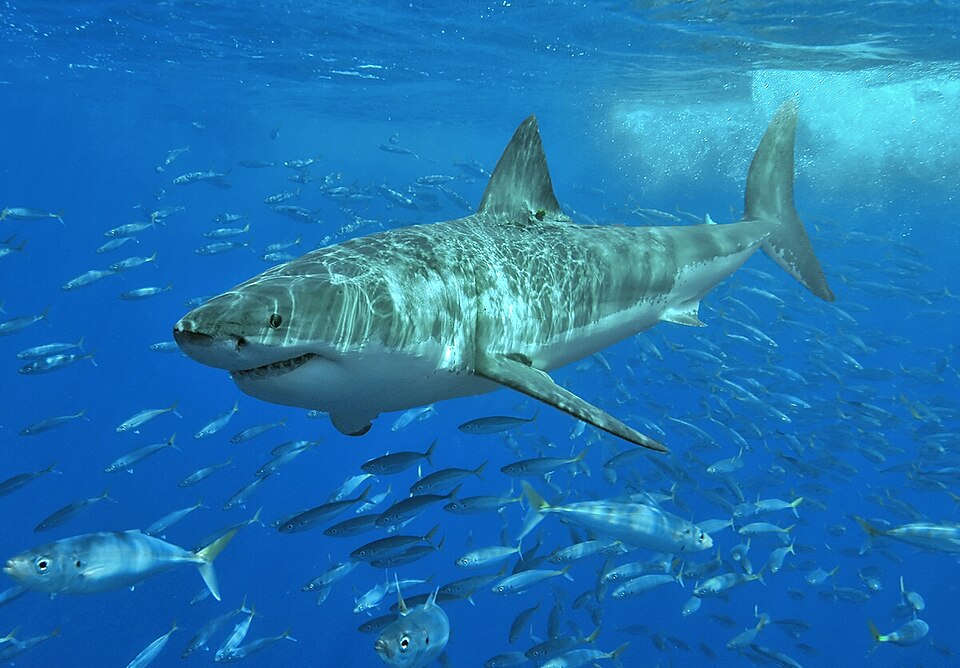
White shark (Carcharodon carcharias): the diet described by NOAA changes as the animal grows.
The facts in one table
| Feeding type | carnivore |
| Diet overall | Diverse and opportunistic: fish, invertebrates and marine mammals |
| Juveniles | Bottom fish, smaller sharks and rays, schooling fish and squid |
| Large adults | Gather around seal and sea lion colonies; also scavenge dead whales |
| Length | ≤ 6.4 m (adult) |
| Weight | ≤ 2041 kg |
| Lifespan | 30–70 years (estimated) |
Source for each row: NOAA Fisheries, white shark species page.
Source: NOAA Fisheries
The same shark eats different things as it grows
The most useful thing to understand about shark diets is that they are not fixed for life. A young white shark hunts prey it can actually handle: fish near the bottom, schooling fish, squid, smaller sharks and rays. As the animal puts on length and mass, marine mammals come within reach, and NOAA notes that larger white sharks often gather around seal and sea lion colonies to feed. Scavenging is part of the picture too — a dead whale is an enormous, undefended meal.
That progression explains why "sharks eat people" is such a poor description of the animal. Humans are not a prey category in the species account at all; the listed prey are fish, invertebrates and marine mammals. Encounters happen, but they are not what the animal is built around or what it looks for.
Source: NOAA Fisheries
There are hundreds of shark species, with hundreds of diets
The white shark is a good example precisely because it is extreme. Across the group, diets range from plankton filtered in open water by the largest species, through crustacean and mollusc specialists that crush shells, to small bottom-dwelling sharks that take worms and shrimp. Asking "what do sharks eat" is a bit like asking what birds eat: the honest answer has to name a species before it can name a food.
Source: NOAA Fisheries
Size, weight and age
NOAA gives the white shark about 4 feet at birth and up to 21 feet as an adult (roughly 1.2 to 6.4 m), with a weight of up to 4,500 pounds, around 2,041 kg. Age is harder: the species page says maximum age is hard to determine and that estimates range from 30 to over 70 years old. That uncertainty is normal for large, slow-growing ocean animals and is a reason to treat round numbers in popular articles with suspicion.
Size is also what ties the whole diet question together. A four-foot newborn and a twenty-one-foot adult are, functionally, two different predators sharing a name, and the prey list NOAA gives reflects that gap rather than smoothing it over. Any answer to "what do sharks eat" that does not say how big the shark is has skipped the most important variable.
Source: NOAA Fisheries
What most people get wrong
- "Sharks hunt humans." The NOAA prey list for the white shark is fish, invertebrates and marine mammals. People are not on it.
- "A shark eats constantly." Large white sharks concentrate where food is predictable, such as seal colonies, and will take a scavenged whale carcass when one is available — that is energy management, not constant hunting.
- "All sharks are predators of big animals." The largest sharks of all are filter feeders, and many small species live off invertebrates on the sea floor.
Source: NOAA Fisheries
Frequently asked questions
- What do white sharks eat?
- NOAA Fisheries describes a diverse and opportunistic diet of fish, invertebrates and marine mammals, with juveniles taking bottom fish, smaller sharks and rays, schooling fish and squid.
- How big does a white shark get?
- NOAA gives about 4 feet at birth and up to 21 feet (about 6.4 m) as an adult, with a weight of up to 4,500 pounds (about 2,041 kg).
- How long do white sharks live?
- The NOAA species page gives 70 years or more, while noting that maximum age is hard to determine and estimates range from 30 to over 70 years.
How to read the numbers
The numbers on “What do sharks eat?” come from the facts table at the top, with the official source alongside.
Where the data comes from
Each section of “What do sharks eat?” names its source (agency, university or breed club) with a verification date.
What this page doesn’t replace
Educational information, not a substitute for a vet, agronomist or specialist assessing your specific case.
Words on this page
Toxicity
A plant’s or substance’s capacity to harm an organism, which varies with the species exposed, the amount ingested and the animal’s size. A plant "toxic to dogs" is not necessarily toxic to humans at the same dose, and the reverse holds too.
Standard definition by ASPCA — Animal Poison Control Center · Toxicity
Life cycle
The sequence of stages an organism passes through from birth to death — for an animal, young, adult and senior; for a plant, germination, growth, flowering and, in annuals, death after setting seed.
Hypoallergenic
A term used for breeds that shed less allergen into the environment, usually because they shed less fur. No dog or cat breed is fully allergen-free: a cat’s main allergen comes from saliva and skin, not only fur, and a very sensitive person can react to any breed.
Standard definition by American Kennel Club · Hypoallergenic
Hemisphere
Half of the globe split by the equator. The seasons flip between the two: when it is winter in the northern hemisphere, it is summer in the southern one, which shifts the pruning, bloom and harvest calendar described on this page.
Dormancy
The period when a plant slows its metabolism and stops visible growth, usually in autumn and winter, to survive cold or drought. Pruning, transplanting or fertilising during dormancy is usually less stressful for the plant than doing it in full growth.
Formative pruning vs. maintenance pruning
Formative pruning happens in a plant’s first years and sets the permanent shape of the main branches; maintenance pruning is yearly, removes dead, diseased or crossing branches, and does not change the plant’s architecture. Mixing the two up is the most common reason a fruit tree fails to bear fruit.
Sources
- White Shark — NOAA Fisheries. Checked on 2026-10-07.