How long do goldfish live?
Far longer than the bowl suggests. The RSPCA notes that while many people think goldfish live about five years and reach about 12 cm, they are known to live for up to 25 years and some reach over 30 cm. The gap between that and the usual experience is not biology: it is housing. The same guidance gives a minimum of about 60 litres of water per goldfish, which is more than most of the tanks these fish are sold with.
Updated on 2026-10-07.
These are population figures, not a prediction for one animal, and nothing here is a care plan. For anything about a specific animal's health, weight or age, consult a veterinarian.
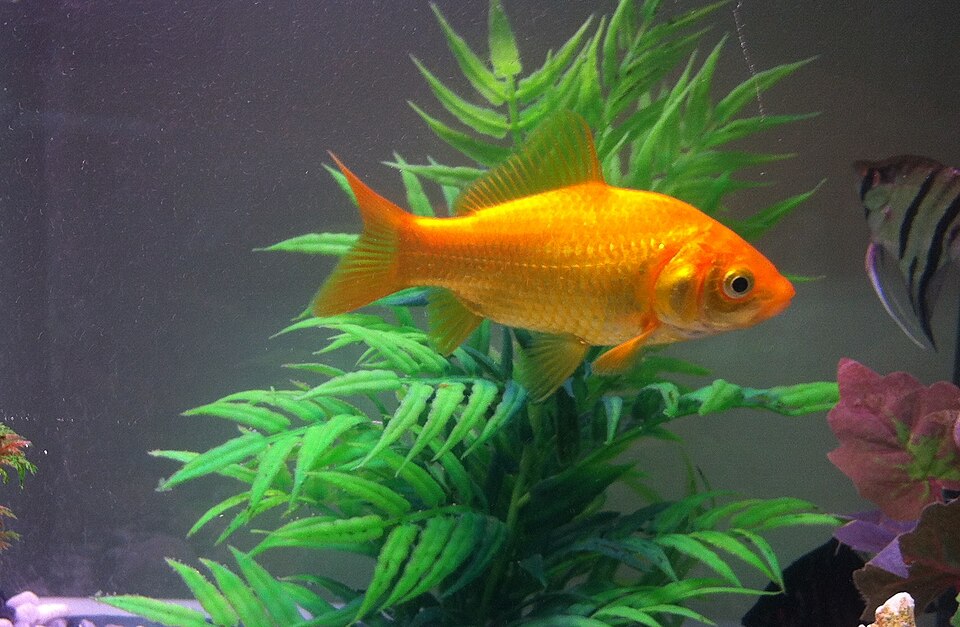
Goldfish: a potential 25 years and over 30 cm, rarely reached in a small tank.
The facts in one table
| Known lifespan | Up to 25 years |
| Adult size reached | Over 30 cm in some fish |
| Common assumption | About 5 years and about 12 cm — both wrong |
| Water needed | At least about 60 litres per goldfish |
| Rule of thumb | About 2 litres per 0.5 cm of fish length, as a rough guide only |
| New tank | May not be ready for fish for two to four weeks while bacteria establish |
Rows from RSPCA guidance on keeping fish and from the University of Illinois College of Veterinary Medicine on pet fish care.
Sources: RSPCA · University of Illinois College of Veterinary Medicine · American Veterinary Medical Association
The tank decides the lifespan
A goldfish that lives five years and stays at 12 cm has usually been limited rather than aged. The RSPCA figure of at least 60 litres per fish, with a rough guide of about 2 litres per 0.5 cm of body length, describes the volume needed to keep waste concentrations survivable — and the charity is careful to call it a guideline only, because water quality depends on filtration, feeding and maintenance too.
That is the honest answer to "why did my goldfish die so young". The animal's potential is 25 years and over 30 cm; a small unfiltered container does not get anywhere near either, and the usual cause of death is accumulated nitrogenous waste rather than old age.
Source: RSPCA
Why a new tank is not ready for fish
The University of Illinois College of Veterinary Medicine makes a point that explains an enormous number of early deaths: new tanks may not be ready for fish for two to four weeks, because adding fish before the tank has established its normal equilibrium of bacteria exposes them to toxic levels of waste. The bacteria that convert ammonia to nitrite and nitrite to nitrate have to build up first, and nothing in the water looks different while they are missing.
The same source frames routine care as monitoring rather than reacting: measuring ammonia, nitrite and nitrate along with temperature, pH and dissolved oxygen, and correcting problems before they harm the fish. For a fish whose potential lifespan is measured in decades, that is the difference between keeping it and replacing it.
Source: University of Illinois College of Veterinary Medicine
What this page will not do
There is no dosing advice here, and no treatment for a sick fish. Fish medicine is genuinely species- and water-specific, and the AVMA's own material on choosing a pet fish is built around asking a veterinarian the right questions rather than self-prescribing. If a fish is behaving abnormally, the sequence is to test the water and consult a veterinarian who sees fish.
These are population figures, not a prediction for one animal, and nothing here is a care plan. For anything about a specific animal's health, weight or age, consult a veterinarian.
Sources: American Veterinary Medical Association · University of Illinois College of Veterinary Medicine
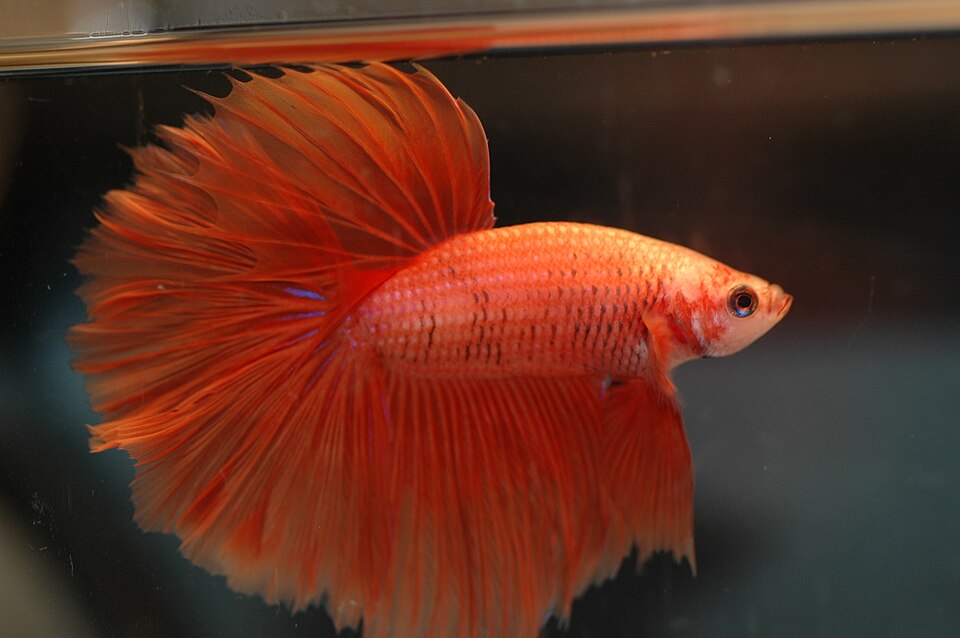
Betta splendens: a much shorter-lived fish, reported at around 1 to 2 years in laboratory conditions.
What most people get wrong
- "Goldfish live a few years." The RSPCA records them living up to 25 years, and explicitly names the five-year assumption as a misconception.
- "Goldfish stay small." Some reach over 30 cm; small size in a small tank is a limitation, not the species.
- "A bowl is fine." RSPCA guidance gives a minimum of around 60 litres of water per goldfish.
- "A new tank is ready once it is filled." It may take two to four weeks for the bacteria that process waste to establish.
Sources: RSPCA · University of Illinois College of Veterinary Medicine
Frequently asked questions
- How long can a goldfish live?
- Up to 25 years, according to RSPCA guidance, with some fish reaching over 30 cm in length.
- How much water does a goldfish need?
- At least about 60 litres each, with a rough guide of about 2 litres per 0.5 cm of fish length — treated as a guideline, since water quality depends on many other factors.
- Why do goldfish often die young?
- Usually water quality and tank volume rather than age. A new tank can take two to four weeks to establish the bacteria that process waste, and overcrowding raises waste concentrations.
How to read the numbers
The numbers on “How long do goldfish live?” come from the facts table at the top, with the official source alongside.
Where the data comes from
Each section of “How long do goldfish live?” names its source (agency, university or breed club) with a verification date.
What this page doesn’t replace
Educational information, not a substitute for a vet, agronomist or specialist assessing your specific case.
Go deeper at the official source
To go deeper than “How long do goldfish live?”, the source named below publishes the original document.
Words on this page
Life cycle
The sequence of stages an organism passes through from birth to death — for an animal, young, adult and senior; for a plant, germination, growth, flowering and, in annuals, death after setting seed.
Hypoallergenic
A term used for breeds that shed less allergen into the environment, usually because they shed less fur. No dog or cat breed is fully allergen-free: a cat’s main allergen comes from saliva and skin, not only fur, and a very sensitive person can react to any breed.
Standard definition by American Kennel Club · Hypoallergenic
Toxicity
A plant’s or substance’s capacity to harm an organism, which varies with the species exposed, the amount ingested and the animal’s size. A plant "toxic to dogs" is not necessarily toxic to humans at the same dose, and the reverse holds too.
Standard definition by ASPCA — Animal Poison Control Center · Toxicity
Dormancy
The period when a plant slows its metabolism and stops visible growth, usually in autumn and winter, to survive cold or drought. Pruning, transplanting or fertilising during dormancy is usually less stressful for the plant than doing it in full growth.
Hardiness zone
A numbered band that ranks a region by the average coldest winter temperature it reaches, used to tell whether a plant survives there outdoors. The reference system is the US one (USDA), from zone 1, coldest, to 13, warmest.
Standard definition by USDA — Agricultural Research Service, Plant Hardiness Zone Map · Hardiness zone
Hemisphere
Half of the globe split by the equator. The seasons flip between the two: when it is winter in the northern hemisphere, it is summer in the southern one, which shifts the pruning, bloom and harvest calendar described on this page.
Sources
- Keeping fish as pets — RSPCA. Checked on 2026-10-07.
- Care and Feeding of Your Pet Fish — University of Illinois College of Veterinary Medicine. Checked on 2026-10-07.
- Selecting a pet fish — American Veterinary Medical Association. Checked on 2026-10-07.