What do pandas eat?
Bamboo, and an astonishing amount of it. The Smithsonian's National Zoo puts the daily intake at 70 to 100 pounds — roughly 32 to 45 kg — and says a panda has to spend 10 to 16 hours a day foraging and eating to get there. The reason is not appetite but plumbing: the zoo notes that the panda's digestive system is more similar to that of a carnivore than a herbivore, so most of what goes in is not absorbed.
Updated on 2026-10-07.
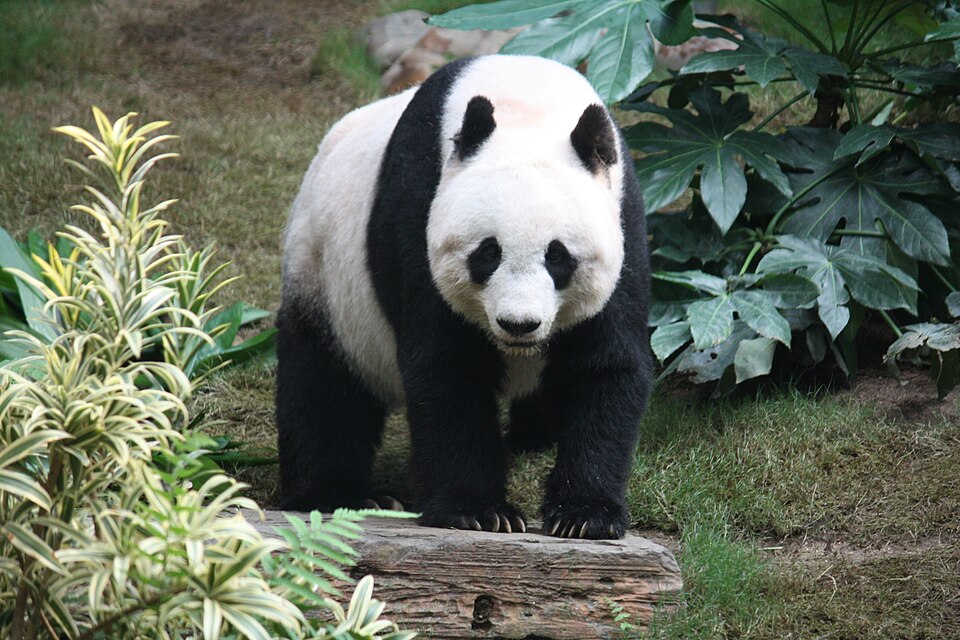
Giant panda (Ailuropoda melanoleuca) handling bamboo with the "pseudo thumb" described by the Smithsonian.
The facts in one table
| Feeding type | herbivore with a carnivore's gut |
| Main food | Bamboo, crushed with powerful jaws and strong teeth |
| Why so much of it | The digestive system is closer to a carnivore's than a herbivore's, so little is absorbed |
| Weight | ≤ 113 kg (male) |
| Eaten per day | 32–45 kg per day |
| Hours spent eating | 10–16 hours a day |
| Lifespan | 15–20 years (in the wild) |
| Lifespan | ≥ 30 years (in human care) |
Source for each row: Smithsonian's National Zoo and Conservation Biology Institute, giant panda page.
Source: Smithsonian's National Zoo and Conservation Biology Institute
A carnivore's gut on a plant diet
The giant panda is the clearest example in mammals of an animal whose diet and anatomy disagree. Its gut is short and simple, like a meat-eater's, with none of the long fermentation chambers that let a cow or a deer break down tough plant material efficiently. Bamboo passes through fast and poorly digested, so the only way to extract enough energy is volume — which is exactly what the 70 to 100 pounds a day figure describes.
The body has adapted around the food in other ways. The Smithsonian describes a "pseudo thumb" used to handle bamboo, and powerful jaws and strong teeth that crush the tough, fibrous stems into bits. Those are solutions to a mechanical problem: a panda has to reduce an enormous mass of woody grass to something swallowable, every single day.
Source: Smithsonian's National Zoo and Conservation Biology Institute
Why pandas look lazy
Ten to sixteen hours of feeding leaves very little of the day for anything else. The low-energy reputation is not laziness but arithmetic: when your food is poor and your digestion is inefficient, the winning strategy is to move as little as possible and chew as much as possible. Most of what looks like idleness in a panda enclosure is the other half of the same budget — resting to avoid spending what the bamboo barely covers.
Source: Smithsonian's National Zoo and Conservation Biology Institute
Size and lifespan
The Smithsonian gives wild males up to about 250 pounds (113 kg), with females rarely reaching 220 pounds (104 kg). Lifespan in the wild is estimated at about 15 to 20 years, and about 30 years in human care, with some individuals reported as old as 35. The gap between the two figures is normal for a species whose wild numbers are hard to follow over a lifetime.
Those numbers put the daily intake in perspective. A 100-kilogram animal working through 32 to 45 kg of bamboo means roughly a third of its own body weight passes through it every day — a ratio no large carnivore or ruminant comes close to, and the clearest single measure of how poor the food is.
Source: Smithsonian's National Zoo and Conservation Biology Institute
What most people get wrong
- "Pandas are herbivores." They eat like herbivores but digest like carnivores, which is exactly why they need such a huge daily volume of bamboo.
- "Pandas eat 20 to 40 pounds a day." The Smithsonian's National Zoo gives 70 to 100 pounds; lower numbers circulate widely and do not match the zoo's own figure.
- "They are lazy." Spending 10 to 16 hours a day feeding and resting the rest is the only way the energy budget closes.
Source: Smithsonian's National Zoo and Conservation Biology Institute
Frequently asked questions
- How much bamboo does a panda eat a day?
- The Smithsonian's National Zoo gives 70 to 100 pounds of bamboo a day, which is roughly 32 to 45 kg.
- How long do pandas spend eating?
- Ten to sixteen hours a day foraging and eating, according to the Smithsonian.
- Why do pandas eat so much?
- Because their digestive system is more similar to a carnivore's than a herbivore's, so they absorb relatively little from bamboo and have to make it up in volume.
- How long do pandas live?
- About 15 to 20 years in the wild as an estimate, and about 30 years in human care, with some individuals reported as old as 35.
How to read the numbers
The numbers on “What do pandas eat?” come from the facts table at the top, with the official source alongside.
Where the data comes from
Each section of “What do pandas eat?” names its source (agency, university or breed club) with a verification date.
What this page doesn’t replace
Educational information, not a substitute for a vet, agronomist or specialist assessing your specific case.
Words on this page
Toxicity
A plant’s or substance’s capacity to harm an organism, which varies with the species exposed, the amount ingested and the animal’s size. A plant "toxic to dogs" is not necessarily toxic to humans at the same dose, and the reverse holds too.
Standard definition by ASPCA — Animal Poison Control Center · Toxicity
Life cycle
The sequence of stages an organism passes through from birth to death — for an animal, young, adult and senior; for a plant, germination, growth, flowering and, in annuals, death after setting seed.
Hypoallergenic
A term used for breeds that shed less allergen into the environment, usually because they shed less fur. No dog or cat breed is fully allergen-free: a cat’s main allergen comes from saliva and skin, not only fur, and a very sensitive person can react to any breed.
Standard definition by American Kennel Club · Hypoallergenic
Hemisphere
Half of the globe split by the equator. The seasons flip between the two: when it is winter in the northern hemisphere, it is summer in the southern one, which shifts the pruning, bloom and harvest calendar described on this page.
Dormancy
The period when a plant slows its metabolism and stops visible growth, usually in autumn and winter, to survive cold or drought. Pruning, transplanting or fertilising during dormancy is usually less stressful for the plant than doing it in full growth.
Formative pruning vs. maintenance pruning
Formative pruning happens in a plant’s first years and sets the permanent shape of the main branches; maintenance pruning is yearly, removes dead, diseased or crossing branches, and does not change the plant’s architecture. Mixing the two up is the most common reason a fruit tree fails to bear fruit.
Sources
- Giant Panda — Smithsonian's National Zoo and Conservation Biology Institute. Checked on 2026-10-07.