Large dog breeds
The official standards draw the line much more precisely than the word "large" does. The Great Dane standard sets a minimum height of 76 cm for adult dogs and 71 cm for bitches; the St Bernard a minimum of 75 cm and 70 cm; the Newfoundland an average of 71 cm with an average weight of 64–69 kg for males. Below is every breed in our dataset whose standard puts the adult above roughly 50 cm at the withers, with the figures as written.
Updated on 2026-10-07.
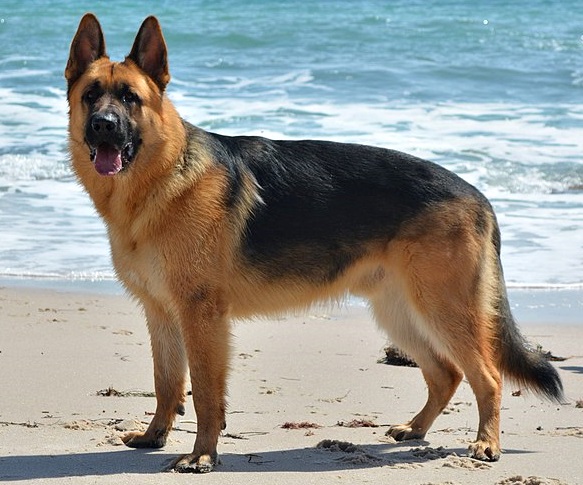
German Shepherd: official ideal height 63 cm for dogs and 58 cm for bitches.
The facts in one table
| Breed | Size | Height | Weight | Life expectancy |
|---|---|---|---|---|
| Great Dane | giant | ≥ 71 cm | — | — |
| St Bernard | giant | ≥ 70 cm | — | — |
| Newfoundland | giant | 66–71 cm | 64–69 kg | — |
| Bernese Mountain Dog | large | 58–70 cm | — | — |
| Dobermann | large | 65–69 cm | — | — |
| Rottweiler | large | 58–69 cm | — | — |
| German Shepherd Dog | large | 58–63 cm | — | 10.16 years |
| Alaskan Malamute | large | 58–64 cm | 34–39 kg | — |
| Siberian Husky | large | 51–60 cm | 20–27 kg | 9.53 years |
| Boxer | large | 53–63 cm | 30–32 kg | 10.04 years |
| Golden Retriever | large | 51–61 cm | — | — |
| Labrador Retriever | large | 55–57 cm | — | 11.77 years |
| Standard Poodle | large | ≥ 38 cm | — | — |
Height and weight as stated in each Royal Kennel Club breed standard. Life expectancy at birth from the VetCompass UK life tables, where the study measured the breed.
Sources: Royal Kennel Club · Royal Veterinary College — VetCompass
Large, and then giant
There are really two tiers in this table. "Large" covers breeds in the 50–70 cm band — the retrievers, the German Shepherd, the Boxer, the sled breeds, the guarding breeds. "Giant" is the handful whose standards set a floor rather than a range: the Great Dane and the St Bernard are specified by minimum height, which tells you the breed is defined by scale in a way a Labrador is not.
It is worth noticing which measurement each standard chooses. Some give height only, some give height and weight, and the ones that give weight tend to be the breeds where mass is part of the type — the Newfoundland's 64–69 kg average for males, the Alaskan Malamute's preferred 39 kg for dogs and 34 kg for bitches. Where the standard is silent, this table is silent too.
Source: Royal Kennel Club
The size and lifespan trade-off is real, but not simple
Across dogs as a group, bigger tends to mean shorter-lived, and the VetCompass numbers in the table bear that out in places: the German Shepherd at 10.16 years and the Boxer at 10.04 years both sit below the 11.23-year average for all dogs. But the Labrador Retriever, a large breed, comes in at 11.77 years, above the average, while the small French Bulldog manages only 4.53 years. Body size is one factor among several, and conformation — particularly flattened faces — can matter more.
The practical takeaway for a large breed is less about the number and more about the years it describes. Growth is slow, joints are loaded, and a giant breed spends a bigger fraction of its life as an old dog. Planning for that, including the cost of veterinary care at 50 kg rather than 5 kg, is part of choosing one.
Coat and exercise: where the work actually is
The sled and mountain breeds in this table — Siberian Husky, Alaskan Malamute, Bernese Mountain Dog, Newfoundland, St Bernard — all have standards describing a dense undercoat, and that is a very different household experience from a Boxer or a Great Dane with a short single coat. The Standard Poodle is the outlier in the group: its standard explicitly describes a coat which does not moult.
Exercise need follows original function more than size. A Border Collie at 53 cm and a St Bernard at 75 cm are both big dogs by most people's standards and have almost nothing in common in terms of daily running. Reading what the breed was built to do is a better predictor than reading how tall it is.
Source: Royal Kennel Club
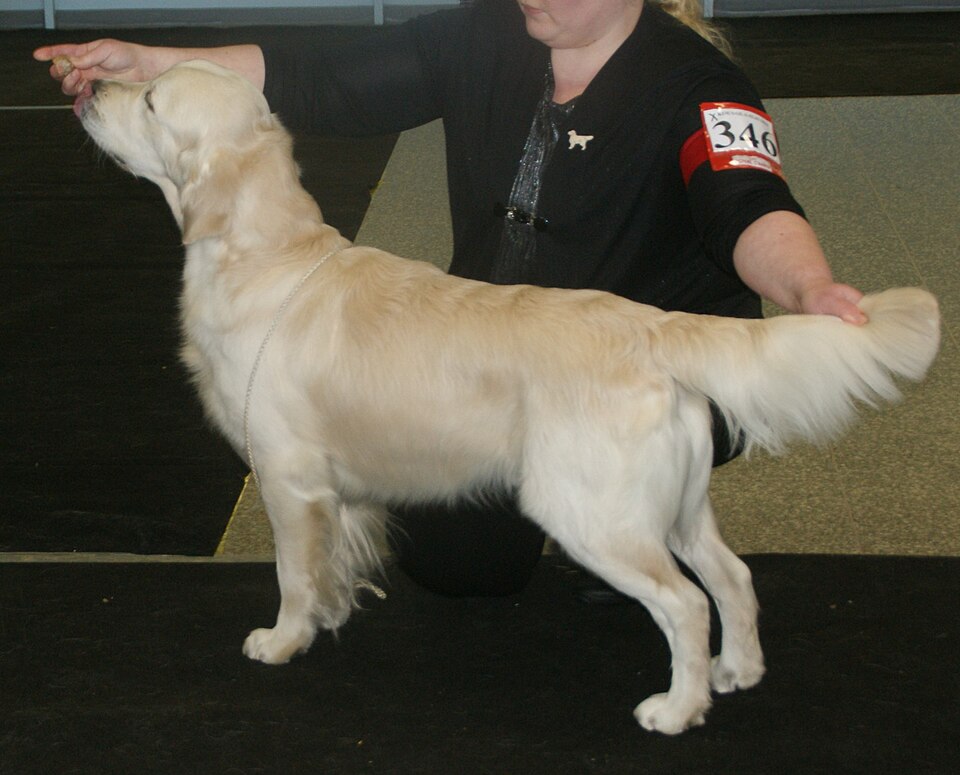
Golden Retriever: standard height 56–61 cm for dogs, 51–56 cm for bitches.
What most people get wrong
- "Big dogs always die young." The Labrador Retriever, at 11.77 years in the VetCompass study, is above the 11.23-year average for all dogs.
- "A big dog needs a big garden." What it needs is daily exercise. A garden is storage, not exercise.
- "Giant breeds are calmer." Some are, but the standards describe working guarding, draught and sled breeds in this list — calm is not a function of mass.
- "Short coat means no shedding." Short single coats shed too; what the standards distinguish is whether there is a dense undercoat behind the topcoat.
Sources: Royal Kennel Club · Royal Veterinary College — VetCompass
Frequently asked questions
- Which is the tallest dog breed?
- Among the breeds here, the Great Dane: its standard sets a minimum height of 76 cm for adult dogs over eighteen months and 71 cm for bitches. The St Bernard standard sets minimums of 75 cm and 70 cm.
- Which large breed lives longest?
- Of the large breeds measured by the VetCompass UK study, the Labrador Retriever at 11.77 years has the highest life expectancy at birth.
- Is there a large breed that does not shed much?
- The Standard Poodle, whose breed standard describes a coat which does not moult. It still needs regular clipping, so low shedding is not the same as low maintenance.
How to read the numbers
The numbers on “Large dog breeds” come from the facts table at the top, with the official source alongside.
Where the data comes from
Each section of “Large dog breeds” names its source (agency, university or breed club) with a verification date.
What this page doesn’t replace
Educational information, not a substitute for a vet, agronomist or specialist assessing your specific case.
Words on this page
Hypoallergenic
A term used for breeds that shed less allergen into the environment, usually because they shed less fur. No dog or cat breed is fully allergen-free: a cat’s main allergen comes from saliva and skin, not only fur, and a very sensitive person can react to any breed.
Standard definition by American Kennel Club · Hypoallergenic
Life cycle
The sequence of stages an organism passes through from birth to death — for an animal, young, adult and senior; for a plant, germination, growth, flowering and, in annuals, death after setting seed.
Toxicity
A plant’s or substance’s capacity to harm an organism, which varies with the species exposed, the amount ingested and the animal’s size. A plant "toxic to dogs" is not necessarily toxic to humans at the same dose, and the reverse holds too.
Standard definition by ASPCA — Animal Poison Control Center · Toxicity
Hemisphere
Half of the globe split by the equator. The seasons flip between the two: when it is winter in the northern hemisphere, it is summer in the southern one, which shifts the pruning, bloom and harvest calendar described on this page.
Hardiness zone
A numbered band that ranks a region by the average coldest winter temperature it reaches, used to tell whether a plant survives there outdoors. The reference system is the US one (USDA), from zone 1, coldest, to 13, warmest.
Standard definition by USDA — Agricultural Research Service, Plant Hardiness Zone Map · Hardiness zone
Formative pruning vs. maintenance pruning
Formative pruning happens in a plant’s first years and sets the permanent shape of the main branches; maintenance pruning is yearly, removes dead, diseased or crossing branches, and does not change the plant’s architecture. Mixing the two up is the most common reason a fruit tree fails to bear fruit.
Sources
- Breed standards — Royal Kennel Club. Checked on 2026-10-07. As medidas de altura e peso citadas vêm do padrão oficial de cada raça; o texto do padrão não é reproduzido aqui.
- Life tables of annual life expectancy and mortality for companion dogs in the United Kingdom (Scientific Reports, 2022) — Royal Veterinary College — VetCompass. Checked on 2026-10-07. 30.563 cães que morreram entre 1/1/2016 e 31/7/2020, sob atendimento veterinário primário no Reino Unido.