Is monstera toxic to dogs?
Yes. The ASPCA Animal Poison Control Center lists Monstera deliciosa — sold as the Swiss cheese plant, the hurricane plant or the cutleaf philodendron — as toxic to both dogs and cats, with insoluble calcium oxalates as the toxic principle. The effects are oral irritation, intense burning and irritation of the mouth, tongue and lips, excessive drooling, vomiting and difficulty swallowing. It is a painful plant rather than a lethal one, and it still warrants a phone call.
Updated on 2026-10-07.
If your animal has eaten part of a plant, do not wait for symptoms and do not try to treat it at home: consult a veterinarian straight away, or call the ASPCA Animal Poison Control Center on (888) 426-4435 or the Pet Poison Helpline on (855) 764-7661.
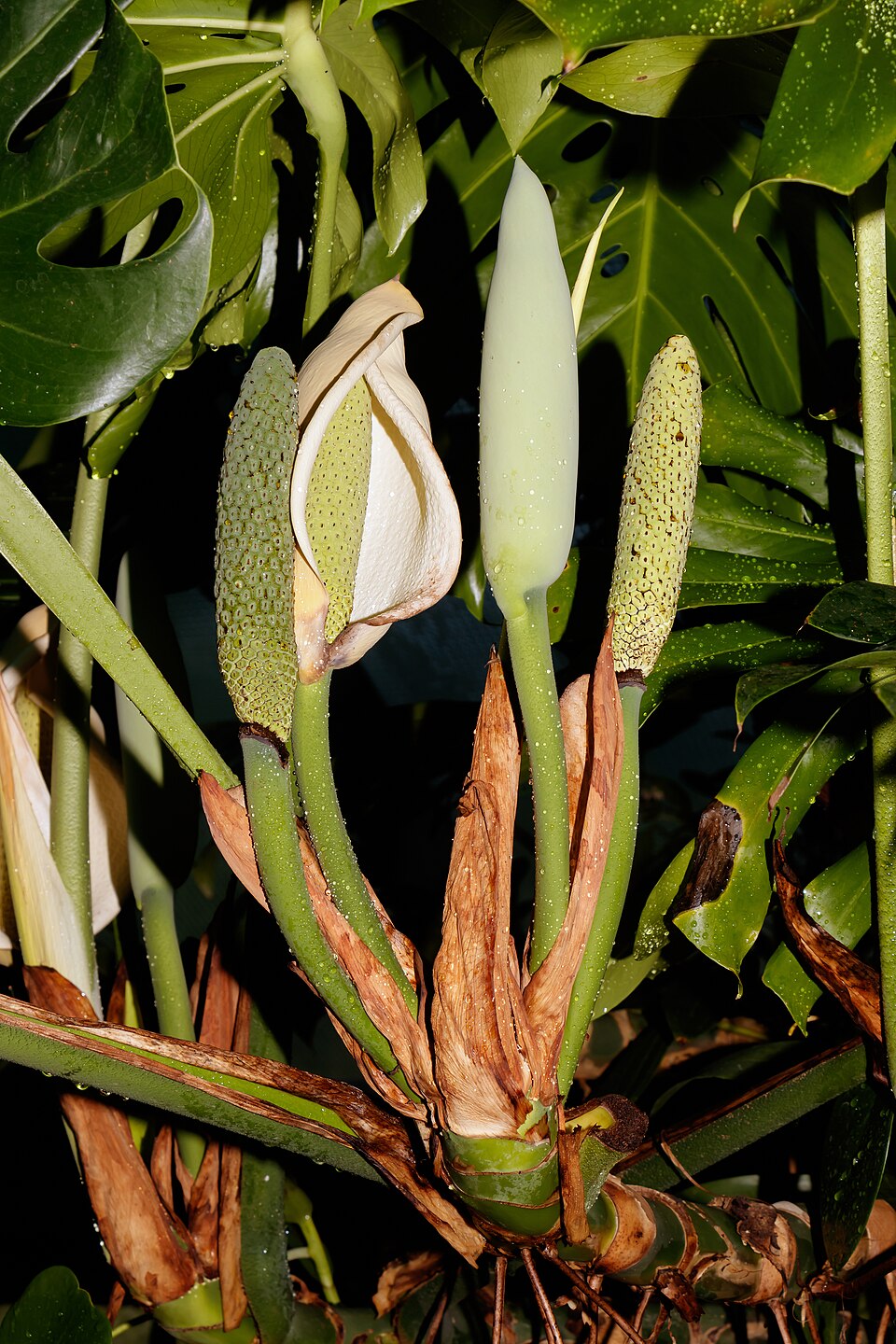
Monstera deliciosa: the leaf tissue holds needle-shaped calcium oxalate crystals.
The facts in one table
| Plant | Monstera deliciosa (Swiss cheese plant, hurricane plant, cutleaf philodendron) |
| Toxic to | Dogs and cats |
| Toxic principle | Insoluble calcium oxalates |
| Effects | Oral irritation; intense burning of mouth, tongue and lips; excessive drooling; vomiting; difficulty swallowing |
| Same mechanism | Golden pothos / devil's ivy, dieffenbachia (which also contains a proteolytic enzyme), philodendron |
Rows from the ASPCA Animal Poison Control Center plant entries for cutleaf philodendron, golden pothos and dieffenbachia.
Sources: ASPCA Animal Poison Control Center · ASPCA Animal Poison Control Center · ASPCA Animal Poison Control Center
Why it hurts so much, so fast
Insoluble calcium oxalates are microscopic needle-shaped crystals held in the plant's tissue. Chewing releases them into the lining of the mouth, where they cause immediate mechanical and inflammatory injury. That is why the ASPCA description reads the way it does — intense burning of the mouth, tongue and lips, with drooling and difficulty swallowing — and why the reaction starts within seconds rather than building over hours.
It is also why most cases are self-limiting. The pain usually stops the animal from eating much, so the exposure tends to be small, and the injury is local rather than systemic. "Usually" is not "always": swelling in the mouth and throat can interfere with swallowing, and that is a situation for a veterinarian to assess rather than an owner.
If your animal has eaten part of a plant, do not wait for symptoms and do not try to treat it at home: consult a veterinarian straight away, or call the ASPCA Animal Poison Control Center on (888) 426-4435 or the Pet Poison Helpline on (855) 764-7661.
Sources: ASPCA Animal Poison Control Center · ASPCA Animal Poison Control Center
The whole Arum family behaves the same way
If monstera is in your house, its relatives probably are too, and they carry the same toxic principle. The ASPCA lists golden pothos, also sold as devil's ivy or taro vine, with insoluble calcium oxalates and the same clinical signs; dieffenbachia, the dumb cane, with oxalates plus a proteolytic enzyme; and philodendron, under several common names. One answer covers the group.
That is useful when you are choosing plants rather than reacting to an incident. A household with a dog that chews can treat the whole family as one category to keep out of reach, instead of checking each new plant individually.
Sources: ASPCA Animal Poison Control Center · ASPCA Animal Poison Control Center · ASPCA Animal Poison Control Center
What to do if your dog chewed one
Call your veterinarian or a poison control centre and describe what happened and what the plant is; a photograph helps, because several very different plants share the common names. Do not attempt home treatment. The reason to call even for a plant whose usual outcome is a sore mouth is that you cannot tell from the outside how much was swallowed or how the airway is doing.
- ASPCA Animal Poison Control Center: (888) 426-4435
- Pet Poison Helpline: (855) 764-7661
If your animal has eaten part of a plant, do not wait for symptoms and do not try to treat it at home: consult a veterinarian straight away, or call the ASPCA Animal Poison Control Center on (888) 426-4435 or the Pet Poison Helpline on (855) 764-7661.
Sources: ASPCA Animal Poison Control Center · ASPCA Animal Poison Control Center
What most people get wrong
- "Monstera is non-toxic because it is a common houseplant." The ASPCA lists it as toxic to dogs and cats via insoluble calcium oxalates.
- "It is only dangerous to cats." The ASPCA entry names both dogs and cats.
- "Mild means ignore it." Swelling in the mouth can affect swallowing, and the amount taken is not something you can judge by looking.
- "Pothos is the safe alternative." It has the same toxic principle and the same clinical signs.
Sources: ASPCA Animal Poison Control Center · ASPCA Animal Poison Control Center
Frequently asked questions
- Is Monstera deliciosa toxic to dogs?
- Yes. The ASPCA lists it as toxic to dogs and cats, with insoluble calcium oxalates causing oral irritation, intense burning of the mouth, drooling, vomiting and difficulty swallowing.
- Which other houseplants have the same problem?
- Golden pothos (devil's ivy), dieffenbachia (dumb cane) and philodendron all contain insoluble calcium oxalates; dieffenbachia also contains a proteolytic enzyme.
- What should I do if my dog chewed a monstera leaf?
- Call your veterinarian or a pet poison control centre, describe the plant and take a photograph. Do not try to treat it at home.
How to read the numbers
The numbers on “Is monstera toxic to dogs?” come from the facts table at the top, with the official source alongside.
Where the data comes from
Each section of “Is monstera toxic to dogs?” names its source (agency, university or breed club) with a verification date.
What this page doesn’t replace
Educational information, not a substitute for a vet, agronomist or specialist assessing your specific case.
Go deeper at the official source
To go deeper than “Is monstera toxic to dogs?”, the source named below publishes the original document.
Words on this page
Toxicity
A plant’s or substance’s capacity to harm an organism, which varies with the species exposed, the amount ingested and the animal’s size. A plant "toxic to dogs" is not necessarily toxic to humans at the same dose, and the reverse holds too.
Standard definition by ASPCA — Animal Poison Control Center · Toxicity
Hypoallergenic
A term used for breeds that shed less allergen into the environment, usually because they shed less fur. No dog or cat breed is fully allergen-free: a cat’s main allergen comes from saliva and skin, not only fur, and a very sensitive person can react to any breed.
Standard definition by American Kennel Club · Hypoallergenic
Life cycle
The sequence of stages an organism passes through from birth to death — for an animal, young, adult and senior; for a plant, germination, growth, flowering and, in annuals, death after setting seed.
Dormancy
The period when a plant slows its metabolism and stops visible growth, usually in autumn and winter, to survive cold or drought. Pruning, transplanting or fertilising during dormancy is usually less stressful for the plant than doing it in full growth.
Hemisphere
Half of the globe split by the equator. The seasons flip between the two: when it is winter in the northern hemisphere, it is summer in the southern one, which shifts the pruning, bloom and harvest calendar described on this page.
Hardiness zone
A numbered band that ranks a region by the average coldest winter temperature it reaches, used to tell whether a plant survives there outdoors. The reference system is the US one (USDA), from zone 1, coldest, to 13, warmest.
Standard definition by USDA — Agricultural Research Service, Plant Hardiness Zone Map · Hardiness zone
Sources
- Toxic and Non-toxic Plants: Cutleaf Philodendron (Monstera deliciosa) — ASPCA Animal Poison Control Center. Checked on 2026-10-07.
- Toxic and Non-toxic Plants: Golden Pothos — ASPCA Animal Poison Control Center. Checked on 2026-10-07.
- Toxic and Non-toxic Plants: Dieffenbachia — ASPCA Animal Poison Control Center. Checked on 2026-10-07.
- Toxic and Non-Toxic Plants List — ASPCA Animal Poison Control Center. Checked on 2026-10-07. A própria ASPCA avisa que a lista "não pretende ser completa", e sim reunir as plantas mais encontradas.