Is aloe vera poisonous to dogs?
Eaten, yes. The ASPCA Animal Poison Control Center lists aloe as toxic to dogs and cats, giving saponins and anthraquinones as the toxic principles. The reported effects are vomiting, lethargy and diarrhoea, with changes in urine colour — described as red — in some cases. The plant's reputation as a remedy for human skin is doing a lot of damage here: a soothing gel on a burn and a chewed leaf in a dog are not the same event.
Updated on 2026-10-07.
If your animal has eaten part of a plant, do not wait for symptoms and do not try to treat it at home: consult a veterinarian straight away, or call the ASPCA Animal Poison Control Center on (888) 426-4435 or the Pet Poison Helpline on (855) 764-7661.
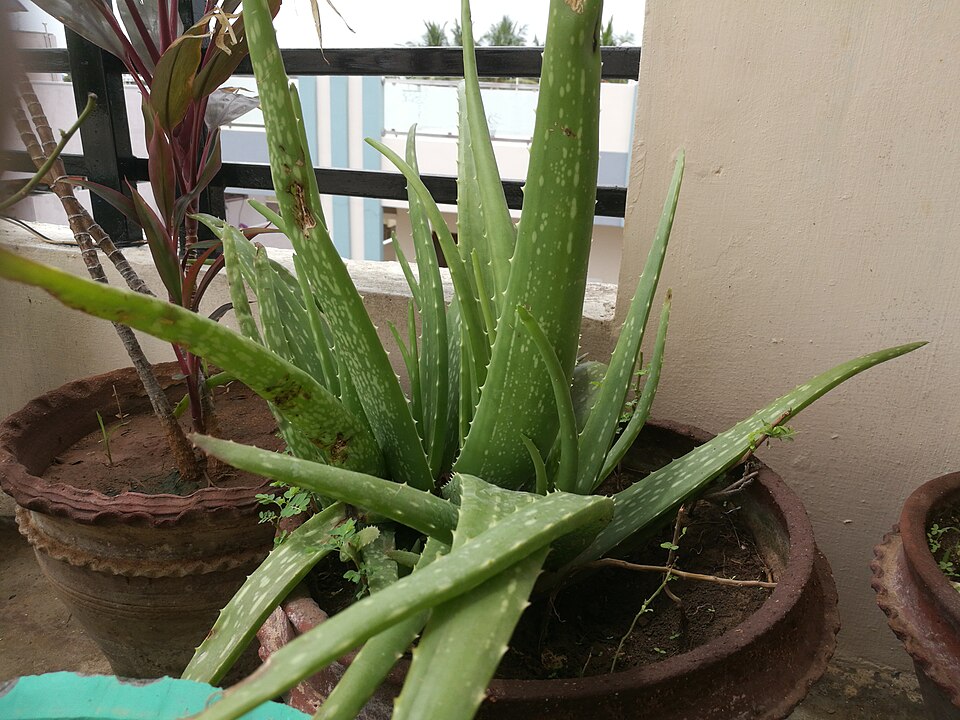
Aloe vera: the irritant latex sits just under the leaf skin, not in the clear inner gel.
The facts in one table
| Plant | Aloe vera (also listed as true aloe, Barbados aloe, medicine plant) |
| Toxic to | Dogs and cats |
| Toxic principles | Saponins and anthraquinones |
| Effects | Vomiting, lethargy, diarrhoea; red-coloured urine reported in some cases |
| Severity | Digestive upset rather than organ failure — but still a reason to call |
Rows from the ASPCA Animal Poison Control Center aloe entries and the Pet Poison Helpline page on aloe vera.
Sources: ASPCA Animal Poison Control Center · Pet Poison Helpline
Saponins and anthraquinones: what they do
Saponins are soap-like compounds that irritate the gut lining, and anthraquinones have a laxative effect — which is precisely why aloe latex has been used as a human purgative. In a dog that has chewed a leaf, the combination produces the picture the ASPCA describes: vomiting, lethargy and diarrhoea. The red urine reported in some cases is linked to pigments in the plant rather than to bleeding, but it is alarming to see and is one more reason to have a veterinarian look rather than guess.
The compounds are concentrated in the latex just under the leaf skin, not in the clear inner gel that gets used on human skin. That distinction explains why the plant can be both a traditional remedy and a listed toxic plant without contradiction, and it also means a dog biting through a whole leaf gets the worst part.
If your animal has eaten part of a plant, do not wait for symptoms and do not try to treat it at home: consult a veterinarian straight away, or call the ASPCA Animal Poison Control Center on (888) 426-4435 or the Pet Poison Helpline on (855) 764-7661.
Sources: ASPCA Animal Poison Control Center · Pet Poison Helpline
How serious is it, honestly
Compared with the plants at the top of the dog list, aloe is a mild entry: the ASPCA's reported effects are gastrointestinal rather than hepatic or cardiac. There is nothing here resembling the sago palm, where the ASPCA reports up to half of ingestion cases as fatal. Scale matters in a toxicity page, and pretending every plant is an emergency is how people stop believing any of it.
What keeps it on the list is that vomiting and diarrhoea are not harmless in a small dog, a puppy or an animal that is already unwell, and that the amount eaten is not something you can estimate from a chewed leaf. A call that ends with "watch and bring him in if it continues" is still the right call.
Sources: ASPCA Animal Poison Control Center · ASPCA Animal Poison Control Center
What to do
Remove what is left of the plant from reach, call your veterinarian or a poison control centre, and say what was eaten and roughly how much. Do not attempt to make the animal vomit or give anything by mouth on your own initiative. If you keep aloe for your own use, the simplest fix is a shelf the dog cannot reach, not a smaller pot.
- ASPCA Animal Poison Control Center: (888) 426-4435
- Pet Poison Helpline: (855) 764-7661
If your animal has eaten part of a plant, do not wait for symptoms and do not try to treat it at home: consult a veterinarian straight away, or call the ASPCA Animal Poison Control Center on (888) 426-4435 or the Pet Poison Helpline on (855) 764-7661.
Sources: ASPCA Animal Poison Control Center · Pet Poison Helpline
What most people get wrong
- "Aloe is medicinal, so it is safe for pets." The ASPCA lists it as toxic to dogs and cats, with saponins and anthraquinones as the toxic principles.
- "The gel and the leaf are the same thing." The irritant compounds are concentrated in the latex just under the leaf skin, not in the clear inner gel.
- "Red urine means internal bleeding." It is a reported effect linked to plant pigments — which is still a reason to have it checked rather than assumed.
- "A mild plant needs no call." In a puppy or a small or already unwell dog, vomiting and diarrhoea are not trivial.
Sources: ASPCA Animal Poison Control Center · Pet Poison Helpline
Frequently asked questions
- Is aloe vera toxic to dogs?
- Yes. The ASPCA lists aloe as toxic to dogs and cats, with saponins and anthraquinones causing vomiting, lethargy and diarrhoea, and red-coloured urine in some cases.
- Is aloe toxic to cats as well?
- Yes — the ASPCA entries list both dogs and cats.
- What should I do if my dog ate aloe?
- Call your veterinarian or a pet poison control centre and say what was eaten and roughly how much. Do not try to induce vomiting or give anything by mouth yourself.
How to read the numbers
The numbers on “Is aloe vera poisonous to dogs?” come from the facts table at the top, with the official source alongside.
Where the data comes from
Each section of “Is aloe vera poisonous to dogs?” names its source (agency, university or breed club) with a verification date.
What this page doesn’t replace
Educational information, not a substitute for a vet, agronomist or specialist assessing your specific case.
Go deeper at the official source
To go deeper than “Is aloe vera poisonous to dogs?”, the source named below publishes the original document.
Words on this page
Toxicity
A plant’s or substance’s capacity to harm an organism, which varies with the species exposed, the amount ingested and the animal’s size. A plant "toxic to dogs" is not necessarily toxic to humans at the same dose, and the reverse holds too.
Standard definition by ASPCA — Animal Poison Control Center · Toxicity
Hypoallergenic
A term used for breeds that shed less allergen into the environment, usually because they shed less fur. No dog or cat breed is fully allergen-free: a cat’s main allergen comes from saliva and skin, not only fur, and a very sensitive person can react to any breed.
Standard definition by American Kennel Club · Hypoallergenic
Life cycle
The sequence of stages an organism passes through from birth to death — for an animal, young, adult and senior; for a plant, germination, growth, flowering and, in annuals, death after setting seed.
Dormancy
The period when a plant slows its metabolism and stops visible growth, usually in autumn and winter, to survive cold or drought. Pruning, transplanting or fertilising during dormancy is usually less stressful for the plant than doing it in full growth.
Hemisphere
Half of the globe split by the equator. The seasons flip between the two: when it is winter in the northern hemisphere, it is summer in the southern one, which shifts the pruning, bloom and harvest calendar described on this page.
Formative pruning vs. maintenance pruning
Formative pruning happens in a plant’s first years and sets the permanent shape of the main branches; maintenance pruning is yearly, removes dead, diseased or crossing branches, and does not change the plant’s architecture. Mixing the two up is the most common reason a fruit tree fails to bear fruit.
Sources
- Toxic and Non-toxic Plants: Aloe — ASPCA Animal Poison Control Center. Checked on 2026-10-07.
- Aloe Vera Is Toxic To Dogs — Pet Poison Helpline. Checked on 2026-10-07.
- Toxic and Non-toxic Plants: Sago Palm — ASPCA Animal Poison Control Center. Checked on 2026-10-07.
- Toxic and Non-Toxic Plants List — ASPCA Animal Poison Control Center. Checked on 2026-10-07. A própria ASPCA avisa que a lista "não pretende ser completa", e sim reunir as plantas mais encontradas.